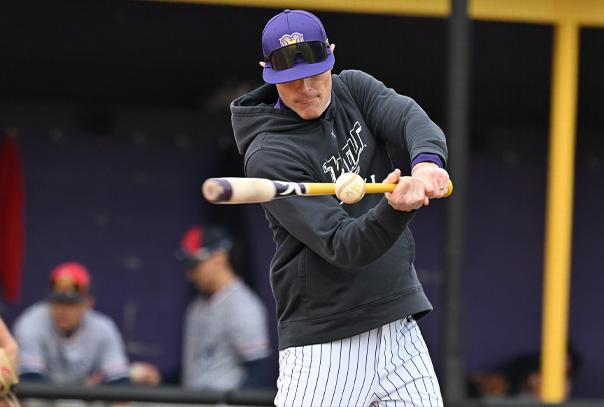
Mike LaRosa completes his sixth season as the head baseball coach at West Chester University in 2026. In his first two campaigns, he led WCU to a regional championship and a return to the NCAA Division II National Championship final round, paving the way for four straight 30-win seasons and three NCAA Regionals hosted in the last four years.
In 2024, WCU set a program record with 39 regular-season victories, posted a school-best 25 conference wins, and assembled a 21-game winning streak—the longest in team history. Previously, LaRosa led Widener University for nine seasons, recording six consecutive 20-win campaigns and a school-record 33 wins in 2014.
A WCU Athletics Hall of Famer, LaRosa starred for the Golden Rams from 2002–05 and had a career batting average of .362. He was a four-time All-PSAC selection and also won the 2003 NCAA Division II National Defensive Player of the Year award.
Inside Pitch: You’ve emphasized the importance of making practices intentionally challenging. What does that look like?
ML: Any time we can make practice competitive, it creates a sense of pressure and urgency. We want players doing everything with a purpose, but that can become monotonous at times. When you attach rewards or consequences to certain outcomes, competitiveness naturally takes over. One example is how we approach bunt defense, which nobody enjoys, right? It can feel dull and repetitive, but we split the group into two teams, bunt live off a machine, and keep score.
Points are awarded for proper execution, such as getting a sacrifice down or making a defensive play, and points are taken away for missed executions or errors. We also let the players chirp and talk a little trash. That energy raises the intensity and forces players into pressure situations that are otherwise difficult to replicate in a practice setting.
IP: Recruiting in Division II can be uniquely challenging. What do you prioritize?
ML: For us, the priority is identifying tough, blue-collar players who put winning at the forefront and fit our culture and style of play. Talent is certainly important, but it is just as critical that we bring in the right people. When you assemble a group that shares the same mindset, work ethic, and competitive approach, you can get everyone pulling in the same direction. It can be easy to overlook those intangibles when a player’s skill set jumps off the page, but we believe strongly in sticking to our recruiting philosophy to ensure every individual fits the culture we’ve built.
IP: How do you go about defining and living out that culture?
ML: We define the values that make up our culture with the acronym H.U.S.T.L.E; hustling is how we approach everything we do. Each letter represents a core principle—Hard Work, Uncommon, Sacrifice, Toughness, Leadership, and Energy—and together they serve as the foundation for who we are. Those values guide how we coach, compete, develop, recruit, and evaluate players. Once they’re here, I’m intentional about reinforcing those principles through daily communication and shared expectations.
IP: As someone who was the National Defensive Player of the Year, what do you think separates a good infielder from a great one?
ML: It’s very simple: great infielders love fielding. It’s easy to find guys who love to hit, but finding players who truly enjoy defense is much harder. Great infielders take pride in the daily minutiae: partner drills, short fungos, focused throwing progressions, all the small details that go into the craft. I tell our infielders that if they want to start, they need to field a minimum of 100 ground balls every day, on top of all their prep work. If you don’t love it, it’s going to be hard to do what’s required each day to become a great infielder.
Beyond that, there are certain traits all elite infielders share: athleticism, quick feet, soft hands, body awareness, and an internal clock. These are qualities we can identify in the recruiting process. But again, if I can tell a player truly loves playing the infield, we feel like we can help them develop everything else from there.
IP: Can you walk us through a typical infield development progression?
ML: First, they go through their partner “daily drills,” which consist of a pick series using different gloves and variations. From there, I really like incorporating short fungo progressions. Having a coach just off the infield dirt, on one knee, hitting short fungos allows the infielder to work gradually through mechanics and fundamentals. We’ll start by fielding with a pad, then move to one-handed work with an infield training glove.
After that, with their regular glove, we focus on freeing up their movements and working on lateral balls. Setting cones helps provide a visual guide for creating proper angles to the ball. As the drill progresses, the fungo hitter gradually moves back until it becomes a full field fungo. By that point, the infielder may have already received 25 to 50 ground balls before transitioning into regular fungos.
IP: Infield play is often about instincts, footwork, and decision-making. How do you help players elevate those skills beyond just physical ability?
ML: While instincts are often viewed as something players either have or don’t have, we try to sharpen them by putting our infielders in as many game-like situations as possible. Another major emphasis is developing their decision-making. Baseball presents countless situations, so our first priority is preparing for the plays they’ll see most often. We’ll vary runners, outs, and game scenarios so they’re constantly processing information, which helps turn decision-making into a habit rather than a reaction.
Beyond that, we spend time discussing and sharing video of less common or unusual plays that can arise during a game. Walking through those situations ahead of time gives players a reference point when they show up in real time.
Footwork development is much more intentional. We break things down using ladders and cones to train a quick first step and proper angles to the ball, but we always try to progress those drills into movement and reads off the bat. As with most skills, repetition leads to improvement, especially when it’s paired with purpose. We also use video to show players their footwork, body positioning, and the timing of their transfers. Video is commonly used for hitters, but it’s often overlooked when training infielders, and it can be extremely valuable in helping them better understand and own their mechanics.
IP: How do you balance the responsibilities of teaching the game with serving as a mentor for your players?
ML: One thing I’ve learned throughout my career is that you have to be yourself. It’s easy to get caught up in acting the way you think a coach should act, but when players feel authenticity, it builds trust, which is a necessary precursor to most everything we do.
Most mornings, I send the team a video that becomes a discussion point before practice. These conversations rarely involve baseball specifically, but are instead about being a great teammate, working hard, responding to adversity, approaching the mental game, and countless other topics we touch on throughout the year. I do worry about the amount of information young people are exposed to through social media, so we try to provide them with positive messaging that supports their growth whenever we can. Everyone needs encouragement and a reliable source of positivity, and young people aren’t typically equipped to look within themselves for confidence, so as coaches, I believe we have a responsibility to help them develop that ability.
IP: What goals or benchmarks are you most focused on as the program moves into its next phase?
ML: Today’s athletes have more options than ever, along with a lot of outside noise influencing their decisions. For us, the priority is creating a positive overall experience that supports both athletic and academic success. Ultimately, if we continue to put our players first, we believe we’ll be positioned to accomplish both our short-term and long-term goals as a program.
For us, putting players first begins with clear and consistent communication. We want our players to know that we are here to support them. Winning matters, but it isn’t the only thing. We closely monitor their academic progress to ensure they’re meeting their goals and on track to graduate, and we make a point to know them as people, not just as players.
Our ultimate goal is to help players separate baseball from their identity. Baseball is something they do; it is not who they are. When the sport becomes someone’s entire identity and then eventually ends, that transition can be difficult. If we can help them establish that perspective while they’re here, they’ll be better prepared for life after baseball. When we do that, the wins tend to take care of themselves.