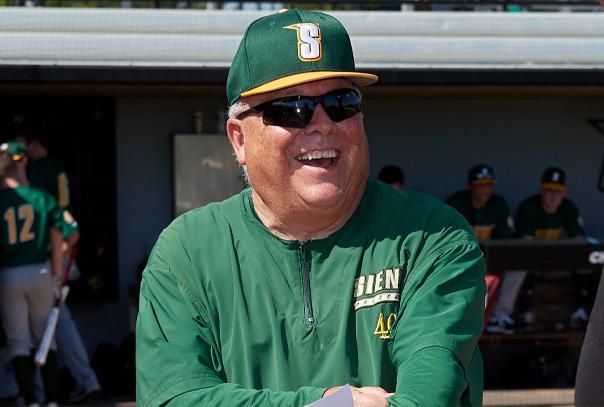
A long list of today’s coaches in college and professional baseball got their start working for one man—the longest-tenured head baseball coach in NCAA history. To this day, I count my lucky stars that I got to be one of them. For many of us in Tony Rossi’s coaching tree, the phone call saying “the job’s yours” was our big break—even if we didn’t know it at the time.
Growing up in Upstate New York in the 1950s, Rossi attended Schenectady Blue Jays—a minor league affiliate of the Phillies—games in his hometown. He idolized Hank Aaron, Ernie Banks, and Stan Musial—figures who embodied his future coaching style and the style of play he instilled in all his teams: respect the game and play hard. A standout amateur shortstop in New York’s Capital region, Rossi played his college baseball at Brockport and turned down professional contracts from both the Reds and the Dodgers in order to complete his degree. Siena College hired Rossi as Head Baseball Coach in 1970. The stipend was a whopping $200 per year, but nonetheless, he embarked on running a college baseball program for the first time, a journey he would continue for the next 53 years.
The winning seasons and list of accomplishments in his career could fill several books, but one of the greatest highlights came in 2014. After a heartbreaking 2-1 loss to TCU in the opening round of the Fort Worth Regional, Rossi’s Siena Saints came back the next day with a 9-8 victory over Dallas Baptist, marking the school’s first NCAA win. He has nearly 1,000 head coaching wins on his resume, along with MAAC championships, Coach of the Year Awards, and multiple Hall of Fame inductions. And he’s coached five big leaguers, from Texas Ranger Gary Holle (1979) through Matt Gage, who debuted with the Blue Jays in 2022. But perhaps his most significant contribution to baseball has been the kickstart and education he provided to so many coaches in our current game.
By the time I met him, Coach Rossi had already been growing the game of college baseball for decades and shaping multiple generations of ballplayers and coaches. I was young, eager, and desperately wanted to carve out a career in coaching, but had no plan on how to go about it. I accepted the job as pitching coach at Siena College in the summer of 2016. Elated at the opportunity, I didn’t know the real gold I had struck; a chance to learn from someone who has made a career out of molding and mentoring assistant coaches.
Lessons we’ve learned from Coach Rossi:
There is never any down time in coaching. There’s always something to do. This belief really revolves around serving the players. There are always ways in which we can spend our time helping our players develop their game. At Siena, when we weren’t working with individual players, corresponding with recruits, or breaking down numbers or film, there was always something to do to improve our facility. Any break in office work usually meant it was about time to go cut the grass, edge the infield, organize equipment, or fix the mounds.
Organization is key. We kept track of everything. Information on recruits and our correspondences, stats, charts, data, and video. And we kept it all in exceptionally organized fashion. We replied to every email, we kept folders for every person, place, and thing you could imagine. He ran a tight ship. Coach Rossi taught us to be detailed and thorough with our record-keeping. To this day, I take notes, store files, and organize my emails the way Coach Rossi did.
Be the first one at the field and the last to leave. I learned that being on the road recruiting can be grueling. When working for Coach, off days from recruiting on the road in the summer were rare. In fact, you could count them on one hand. We were always instructed to be the first ones at the ballpark and to never leave a game until it was over. Not only did this create a habit for us to see every warm-up rep, every AB, and every pitch we needed to, but it allowed us to be seen constantly by the people that mattered in the recruiting process: the players, the travel coaches, and the parents.
Take advantage of every chance to network that you possibly can. Like anyone in the coaching industry knows, networking provides long-term value for your career. As the saying goes, “it’s all about who you know.” While on the road, Coach encouraged us to approach people, strike up conversation, while never losing sight of why you’re there to begin with. When you’re recruiting, you’re there to do a job. Networking is more effective when people see you committed to your job and doing it exceedingly well.
Gotta have levity. We work in a very competitive industry. At times it can be easy to let our egos, team performance, or personal interests get in the way of an enjoyable work environment. And Coach Rossi was as dedicated and as competitive as they come, but he also never let a day go by without pulling pranks, poking fun at us, and even laughing at himself. Coach’s laugh could be heard down the hallway. I can remember countless times my stomach hurt from laughing while sitting in the office with him. We would need to do a separate article to list all of Coach’s best lines and pranks. If assistants ever got heated or upset, Coach was always the first one to ease the tension. We’d share a belly laugh, then get back to work. “Gotta have levity” he would say.
Coaching is a great profession. All of his assistants were young. Many just got done playing and had little to no experience in coaching. We weren’t making much money, scraping by working night jobs and giving lessons—a lifestyle that many baseball coaches know well. But Coach Rossi was generous with his time and guidance. He loved having ambitious assistants who were hungry to “make it” in the industry. His goal for us was to stay the course, embrace the hard work, and keep developing and networking. Coaching was never about the money for him, but he pushed us to strive for new heights in our careers. He always encouraged us by saying “it’s a great profession” because he wanted us to stick with it and experience the joy he’s met through a lifetime of coaching.
Quotes from Coaches under Rossi:
Bill Cilento, Wake Forest, Associate Head Coach
For me it’s easy to point to the thing I learned the most…discipline! Discipline in being there at 4:30am every day! Discipline in his recruiting schedules. His work ethic is second to none. Coach taught us to watch the game, how to observe it. He was the best at it. As far as something I still say today…“Let the game tell you!” He always used to say it.
The other thing I think he does that is unique…he could always laugh at himself. He would never take himself too seriously.
Jimmy Jackson, University of Maryland, Pitching Coach
Coach Rossi taught me everything I know about the importance of networking. He knew it was going to be such a valuable skill for me to have moving forward. He taught me how important it is to build relationships on the road. Building those relationships in order to be a better recruiter and to advance in this profession. Coach also instilled a great work ethic in me. Always be the first one in the office and the last to leave.
Rob DiToma, University of San Francisco, Head Coach
When I got hired at Siena early one summer, Coach Rossi handed me a sheet of recruiting events I was to attend. The only thing that wasn’t on there was a day off. He instructed me to be first at every event and be the last to leave. At the time I thought this was overboard, but it was the best advice I ever received as a young assistant.
He was teaching me to turn every stone and don’t follow the crowd. Most of the jobs I landed later in my life were because the coach that was hiring me would say ‘whenever I get to an event, Rob is always there.’ He taught me that recruiting is going to be where we can gain advantage on the people who don’t want to work as hard as us.
Another thing I learned from Coach Rossi was to make sure you put your stamp and beliefs on what you are teaching and coaching. At the end of my year there he gave me his evaluation of my performance as a coach. He told me some of the hitters were not sure who was in charge of the hitting. He coached me up and said if you want to be something in this profession, your players better know you are the one coaching them and that you deeply believe in them and what you are teaching. I still hear him telling me that to this day.
Peter Larson, New York Yankees, MiLB Pitching Coach
We were young, inexperienced coaches and he took a chance on all of us. He allowed us to explore and fail, but he was always there for advice. Since he was a former schoolteacher, I know he really enjoyed watching us learn from our mistakes to make us better in the long run.
The daily to-do lists seemed crazy in the beginning, but I learned to understand it. He was providing us a better understanding of everything that was needed to prepare for practice, what needed to be organized, everything that goes into the day-to-day of being a good coach. No detail was too small and if you had nothing to do...then go spray paint bases!
Anthony Spataro, James Madison University, Assistant Coach
I think the biggest thing I learned from Coach Rossi is the importance of being organized. Coach gives his staff a tremendous amount of freedom to develop their own identity as coaches, but with that freedom comes very high expectations. He expects you to be someone he can count on in every area of the program—in the office, being there for the players on and off the field, being relentless on the road recruiting. The only way to meet those expectations is by being organized.
Michael Kellar, Illinois Wesleyan University, Head Coach
I had two big takeaways from my time with Coach Rossi. The first was his willingness to let young coaches like myself be an integral part of the program. The roles we were given weren’t just field work and throwing BP. Right from the start, he allowed us to learn what it means to be a coach by actually going out and coaching.
The second was that his expectations of his assistants really prepared you for being a college coach. You were expected to be in the office early, be a relentless recruiter, and go above and beyond in every facet. During those three years I worked for Coach Rossi, I learned an incredible amount, but the work ethic he expected really set me up for the rest of my coaching career—not only to love what I do but also to understand what it takes to be a successful college baseball coach.
Being in Tony Rossi’s “coaching tree” has always been more than just a two- or three-year stint in a Siena uniform; more than just a reference to list on a resume. Being in his tree meant we received an invaluable education on how to carve out a path for ourselves in this career. We learned how to develop young men into leaders, how to think the game, how to win a close one, and how to appreciate and inspire a passion in others for the game that we all love.