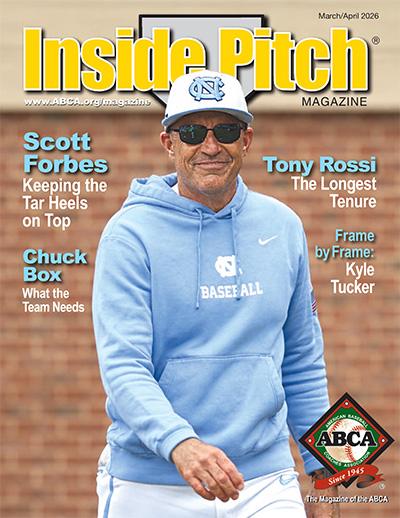
Scott Forbes has kept his North Carolina Tar Heels at the top of college baseball since succeeding Hall of Fame coach Mike Fox in 2021.
A native of Sanford, North Carolina, Forbes played collegiately at Middle Georgia College before transferring to North Carolina Wesleyan, where he played under Fox from 1995–1997.
Forbes began his coaching career in 1999 as an assistant coach at North Carolina. He later served on the coaching staffs at Winthrop University and East Carolina before returning to Chapel Hill in 2006.
Under his leadership, UNC has remained one of the nation’s premier programs, compiling more than 200 career wins, multiple NCAA Tournament appearances, and ACC championships. Forbes was named ACC Coach of the Year in 2024. Known for his emphasis on player development, accountability, and culture, he has continued the Tar Heels’ tradition of sustained excellence.
Inside Pitch: How valuable has it been to have the stability, support, and infrastructure at North Carolina to keep your program at such a high level?
Scott Forbes: That’s a great place to start. I learned from the best in Mike Fox—I call him Coach Fox. Going back to North Carolina Wesleyan, I realized he really knew how to run a program. He had a blueprint. He learned so much from Dean Smith, and I always hoped that if I ever got into coaching, I could be part of something with sustained success.
It’s one thing to have a great year here or there, but I always respected programs that were consistently in the mix. Even in our down years, we felt like we had a chance. A lot of that comes from support. I keep a Nick Saban quote on almost every document I send: “You remain successful as long as the commitment to the process of remaining successful stays in place.” UNC has done that.
When I became a head coach, I knew surrounding myself with the right people was vital. I truly believe I have the best staff in the country—great coaches, great men, unbelievable leaders. And it goes beyond coaches: trainers, strength staff, academic advisors—everyone matters. When everyone does their job at a high level and loves what they do, your chances of success go way up. You also have to adapt to the new landscape and not complain about it—just embrace it and move forward.
IP: You’ve been impacted by legendary figures at UNC—Dean Smith, Roy Williams, Michael Jordan, Mack Brown, Bill Belichick is there now, and of course Coach Fox. Is there a lesson or nugget that really stuck with you?
SF: I’m honestly in awe every day of the coaches at this place. National championship coaches, great people. I try to learn from all of them. Roy Williams has been a huge supporter. I didn’t get to know Dean Smith unfortunately, but he impacted me through Coach Fox. But the day I got the job, Coach Williams sat down with me for a long time and gave me advice.
One thing Coach Fox always emphasized—a combination of John Wooden and Dean Smith—was that it’s amazing what can be accomplished if nobody cares who gets the credit. That’s the beauty of team sports. Everybody has to do their job well for the team to succeed.
There are so many others I’ve taken so much from, including so many of our current coaches here right now.
IP: When you took over for Coach Fox, how much of the program did you keep, and how much did you change?
SF: Roy Williams gave me great advice: you have to be who you are. But I also knew Coach Fox knew how to run a program—his players graduated, he won consistently, he even had experience as an athletic director he drew from and taught me. About 90 percent of what we do is what Coach Fox did. The other 10 percent is just personality differences. The old-school, fundamentals blueprint stayed the same—repetition, discipline, accountability, development, defense, and building the whole person. I never tried to be better or even the same as Coach Fox. I’ve just tried to find ways to improve every day just like when we were together.
IP: You left UNC briefly to coach at Winthrop and East Carolina. What did that experience mean for you?
SF: That was huge for me. When Coach Fox asked me to be his volunteer, it was literally for no money—unpaid—working other jobs to make it work. But I got to work with Chad Holbrook and Roger Williams there too. They took me in as a Division III guy and showed me the ropes. Such a great experience, hitting fungos, helping the other assistants, running camps. And I got to coach a couple summers with the Wilmington Sharks, where I met Scott Jackson.
But that job at Winthrop, I finally had a full-time job with benefits, and I got a car! Coach Joe Hudak even made me the strength coach because we didn’t have one. We won a Big South Championship my last year, and those players bought into everything we were building.
I went briefly to East Carolina to work with Randy Mazey, but Coach Fox called a couple weeks later and asked me to come back as pitching coach; Roger had left for Georgia. I’d never coached pitching before, but I said yes immediately—after all it was [Andrew] Miller, [Josh] Bard, [Robert] Woodard, [Andrew] Carignan, I’m just going to let them teach me! Talk about the right place at the right time!
It was really hard to leave Coach Mazey, who had given me a great opportunity. But I played for Coach Fox, and I’m very thankful how Randy handled it, he just understood.
IP: How did you learn to coach new positions like pitching or strength coach?
SF: I learned by studying, going to clinics, reading, and leaning on great coaches. Being a catcher helped me understand the game and how to manage pitchers. But above all, the most important thing in coaching is loving your players and letting them know you care. Knowledge matters, but relationships matter more. Leaning into being transformational instead of transactional is so important. I just tried to get the guys to believe in themselves, so it was just about instilling confidence.
And of course I read books, watched the videos, went to every ABCA Convention I could. I truly believe you can learn most anything with all the resources out there now. It’s about having the right people.
IP: How do you manage relationships now with the transfer portal and roster turnover?
SF: You keep the players at the center. Treat them with respect. Love them. If a kid leaves, most of the time it’s just coming down to playing time. They just want to play and I respect that, of course. I just want to feel good about how we coached him, supported him, and cared about him. You can’t play everyone, but how you treat the guys who aren’t playing matters.
IP: With sustained success, how do you balance repeating your formula and adjusting year to year?
SF: You have to adapt. You need a mix of high school talent and transfers; too old and it’s hard to sustain, too young and it’s hard to win. It used to be a lot easier to predict your team needs with recruiting, but the portal has changed everything. Our goal is simple: be in the mix every year, host regionals, be deep on the mound, and be athletic enough to compete every game. If you have pitching, you always have a chance.