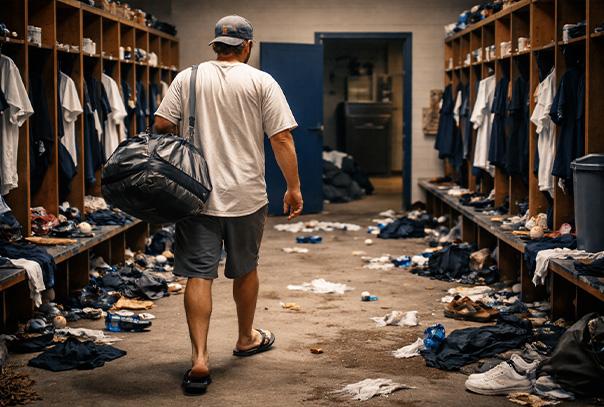
Have you ever heard the expression, “dress for the job you want, not the job you have?” It’s a metaphor that I’ve used over the years in baseball to help get players—and in some instances, coaches—to go about their business in a manner that was reflective of where they wanted to go, rather than where they were. At times, it literally concerned their attire—whether that was dressing to the ballpark inappropriately or wearing their uniforms unprofessionally. The expression also applied when it came to things like effort and attitude. Usually, one simple question would help reset their minds to quickly become aligned to their big picture goals:
If you were making your Major League debut, would you (insert the blank) like you did today?
If you were making your Major League debut, would you arrive at the stadium in your pajamas and flip-flops like you did today? If you were making your Major League debut, would you show up just 15 minutes before you had to be out on the field for early work like you did today? If you were making your Major League debut, would you really coast at half-speed down the line after that routine grounder to short?
Ninety-nine times out of 100, their answer was no. So if someone wasn’t going to act in a certain way in the Major Leagues, it wasn’t going to be an acceptable way to behave on their way up the minor league ladder. The sooner we could get our players down on the farm thinking and acting like Big Leaguers, the more prepared they would be if and when they reached the game’s highest level.
But creating habits and driving behaviors are just pieces of the big picture—the process pieces. There comes a point in time when results matter, and to not also address those expectations is doing a disservice for players and teams alike.
A few years ago, while managing in the minor leagues, my club won a game that we had absolutely no business winning for as embarrassingly bad as we played that night. That’s baseball. When the team got back into the clubhouse, I lit into them.
There was clear confusion on many faces, not understanding why they were getting yelled at after having just won the game. The few players who got “it” got it before I even started. Yes, we were victorious over our opponent, and I was happy about that because the results do matter. But if we brought the same lack of energy, focus, effort, and attention to detail that we displayed that night, we would lose far more than we’d win. Nights like this were unacceptable in A-ball, and they sure as hell were unacceptable in the Big Leagues. I wanted the guys to know that so they could change their lens by the time they left the ballpark. Still to this day, it was the only time I ever went off on the group after a win. And that’s what made the message so much more impactful.
That’s the team side of this. There is also an individual aspect that is equally as important, and it can be scaled from a minor leaguer with Major League dreams to a high school freshman wanting to become a varsity starter one day. Dress for the job that you want. Well, if you want to be a Major League baseball player, you have to know what the expectations are for the game’s highest level and consciously work towards that.
We don’t expect an 18-year-old who just got drafted to be a finished product when they join the organization. They are literally years away from even being in the conversation for a call-up. But they do need to learn that, for instance, if they want to be a shortstop in the Big Leagues, then the expectation is that when a routine ground ball is hit their way, it is a routine out. Every single time. So, when they boot routine plays in games, and throw away routine plays during infield work, they need to recognize themselves that those careless mistakes cannot happen if they want to reach their goals.
That doesn’t mean they can’t make mistakes—far from it actually. What it does mean is that they have an awareness—with every mistake and every successful rep—of what they need to be able to do in order to go where they want to ultimately go.
There is also the concept of catching them when they do something right. If we played great as a team one night and didn’t win, that type of competitive effort needed to be recognized to hopefully pull it out of the group more. Show up like that, and more times than not, you will be shaking hands at the end of the night. If a rookie-ball shortstop has a “boring” day handling all five routine ground balls, routinely, then he needs to know that “boring” wins in the Big Leagues.
When the lens changes from the job you have to the job you want, you are now opening yourself up to massive transformation. When you know you need to get better—without your coach constantly telling you—your work gets better with more focus and intensity behind each rep. And when that happens, development takes off. It’s holding yourself to the highest of standards—the standards that the very best in the game are holding themselves to, night in and night out, under the lights, in front of 50,000, doing the job you want.