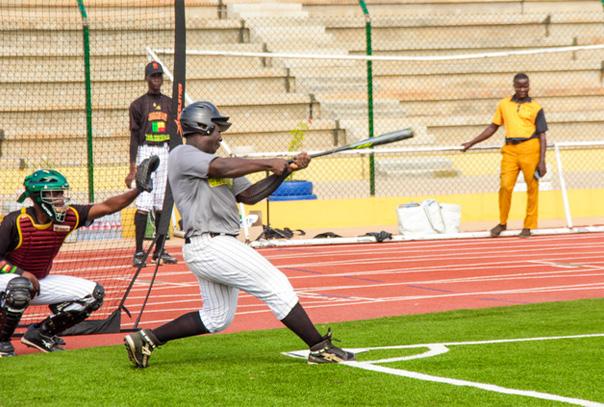
Two years have passed since my article on teaching hitting skills in West Africa appeared in the September/October 2023 edition of Inside Pitch. In the interim, I’ve appreciated both praise and suggestions from other coaches around the globe. The initial feedback, whether online or in person, came largely from ABCA colleagues in the United States. A later round came after a presentation I gave in November 2024 at the European Baseball Coaches Association Convention on building youth baseball programs in Benin.
As we’ve moved further away from pandemic travel restrictions, both our U-23 and U-12 national teams now have competitive international experience under their belts. With that in mind, some coaches familiar with our program have asked, “How’s it working?”, curious about the success (or lack thereof) with our hitting approach. I’ll respond by putting two-strike hitting at the center and say, “Better than expected.”
First, like almost every team, we keep track of and record our outcomes at the plate, both in practice and in games. We do this with both teams. What we’ve found is that when our kids strike out, it happens much more often by swinging than by looking—a big change from the earliest years of the program. Also, both groups, especially the younger guys, have cut down on total strikeouts as a team. This means we’re getting increased contact with two strikes and putting the ball in play, which is something we struggled mightily with as we got started, as you might imagine. Whether it’s a base hit or not, we value contact and putting the ball in play across all of our age groups.
How did we do this? By working on two-strike hitting skills in every practice for each team, whether we’re drilling down on individual swing mechanics, or having team BP. Having said that, we approach this a little differently for each group. For example, with the U-23s, we use far more single arm swings, top hand and bottom hand each. We isolate each arm on both our tee and toss and hit drills. The older group also takes Situational BP, just as I described it in the original article, with two-strike counts as a big part of it.
As examples, here are a couple of drills from a recent U-12 team practice, led by Fernando Atannon, head coach of Benin’s national U-12 and U-23 teams. At this workout, the coaches created three lines of hitters behind home plates placed along the first baseline. The plates are separated by about 30 feet. Each tee is at a different location on each plate, but all within the strike zone.
That is, the tee on the first plate is placed for a pitch inside to a right-handed hitter (making it outside for a lefty), the tee on the second plate is down the middle, roughly waist-high, and placed on the plate’s front edge (we move this up slightly from there, but want to keep the ball in the strike zone here, so this isn’t necessarily the customary “high tee” drill), while the third tee is away for a righty hitter (and in for a lefty).
Our U-12 team is currently comprised of 12 players, which means lines of four guys to a tee. A coach is stationed to both place balls on each tee and to remind or correct each player on our preferred two-strike stance, which is an adjustment for most of our players.
As I described it in the first article, we encourage our players to choke up on the bat about two inches up from the knob and take an open stance, similar to what you might see from a fake-bunt/slash setup, but without the fake bunt. The back foot is placed two to three inches from what would be the batter’s box inside vertical line (closest to the plate) and at least six inches from the back point of the plate, if not more. We want the hitter’s front foot in alignment with the plate’s inside corner, a few inches away from what would be the batter’s box outside vertical line (furthest from the plate).
Each player gets swings at each tee, looking to hit the ball with a short, compact stroke—the bat barrel moving in a direct path from the hitter’s back shoulder to the ball. Again, we’re focusing on making contact—not aiming for the fences or outfield gaps—and putting the ball in play. The hitter then moves to the end of the next line and will swing at balls on the following two tees, using the same stance and compact swing.
We moved next to a bucket drill, with a coach behind an L-screen placed about 25 feet in front of home plate. The team is still split into three groups of four, with a group at the plate, a second group positioned at the four infield spots, and the third group spread out in the outfield.
Each overhand toss from the coach (sitting on the bucket) is intended to simulate a good Little League fastball, both in height and velocity. Each hitter is instructed to swing at every pitch that’s either a strike or close to it. As I pointed out in the first article, the only decision we want our hitters to make is not to swing, because they go to the plate otherwise ready to make contact with every pitch.
In order to emphasize this swing-first, attack-oriented approach, we do not correct or criticize our players for swinging at pitches “on the black” or slightly outside the strike zone. Any coach at virtually every level of play across the globe will know that with two strikes, pitches on the borderline or a ball-width (or more) off the plate can and will be called strike three. We believe this approach prepares our hitters to handle this in-game reality.
The bucket drill continues as each hitter runs out their last swing to give the defense a live repetition. If the hitter reaches base safely, he can try to advance to the next base on any ball hit in fair territory, with the fielders playing each ball off the bat like in a game. The group at the plate finishes after the fourth hitter takes his swings.
The hitters then move to the outfield, as that group moves to the infield and the infielders head in to take their swings at the plate. We add a competitive element by giving the teams a chance to score runs during every four-hitter sequence.
Now, coming to the United States and changing an entire team’s batting stances would be quite an interesting endeavor. But it’s important to remember that the great majority of the players on both teams have been involved with baseball for fewer than five years. With that in mind, we continue to refine our teaching approach to better serve these players in all aspects of the game, giving more freedom to certain players who have the light bulb come on a little sooner than others.
The good news is that we’ll have more opportunities to do so on the recently refurbished, larger field space on the grounds of CEG Nokoue High School in Cotonou. Highlights of the fall 2025 season included our participation in the WSBC U-23 championship for Africa, held in Cape Town, South Africa, in November, and the Little League International tournament for West Africa in Nigeria in December for our U-12s.
As our overall skill levels improve—including two-strike hitting—it’s clear Benin’s national teams are ready for more challenges. Thanks for reading, and hopefully you can apply some of these offensive and practice concepts to your teams.