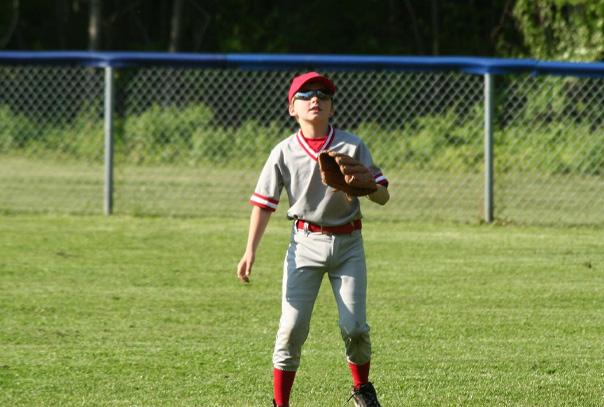
I am not sure what happened to the time-honored tradition of taking “infield” before high school and youth games, but what I commonly see now for warm-ups are coaches hitting balls to lines of infielders and outfielders, which is okay for eight-year-olds. If your players are older than that, here are some thoughts to help your outfielders in particular:
First, every field condition should be accounted for—weather, sun, wind, local ground rules, type of playing surface, type of outfield fence, amount of foul territory, and size of the warning track (including counting steps at full speed from the warning track to the wall).
Second, every footwork pattern in all directions should be trained in a dynamic movement and athletic preparation phase of the warm-up. The drills should train both reaction and action, and include both verbal and non-verbal cues. You can also apply this same concept with pregame throwing—“do-or-die” fly balls or grounders, balls at the fence, balls in sun, etc. The idea is that before the first pitch, every throw and footwork pattern should be practiced.
The most common mistake made by teams during high school and youth games is not what they do during a play. The mistake lies in what they fail to do before the play begins: they fail to communicate. Communication is the lifeblood of team defense. It must occur before every hitter and after every time a runner advances or scores.
Outfielders must have a system of communicating non-verbally about what they’ll do if the ball is hit in the air, on the ground, at them, or in a gap. Each of those things may require a throw to a different base and/or relay person. Of course, the game situation may dictate different actions too, such as letting a deep foul ball drop when the tying or winning run is on third with less than two outs.
This can be practiced in warm-ups by calling out a game situation to the outfielders before each ball is hit to them. As I learned from Hall of Fame coach Ed Cheff many years ago, if coaches expect their players to be able to field balls with all types of speed, spin, distance, direction, and height, coaches should be proficient at hitting all of them. If a coach is not proficient yet at doing this, a machine should be used. Accuracy is critical for proficiency.
All balls caught by an outfielder should be thrown to an infielder—who could be positioned with verbal commands from a catcher—and proper relay and tag fundamentals can also be taught during these reps. As many coaches know, these plays can make the difference between winning and losing.
Outfielder warm-ups begin long before a ball is hit to them in a game, and can involve infielders and catchers as well. Finding ways like this to practice team defense is a great way to prepare for a game.
Anything less and the team is likely to fail, because they’ve failed in their preparation. Remember, you don’t just take “infield” before the game!