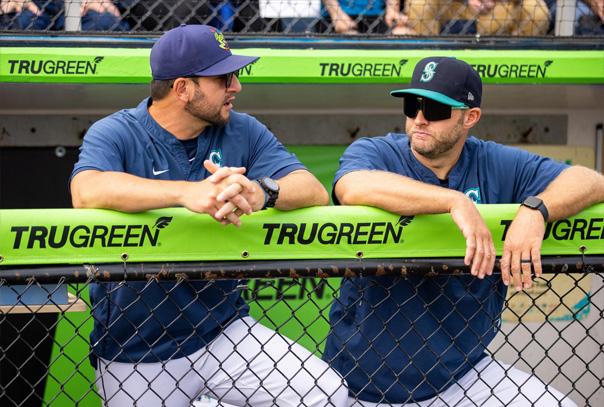
Kellen Lee completed his third season as a Mental Skills Coach in the Seattle Mariners organization in 2025, working with players and coaches to develop competitive, confident mindsets. Lee has a Master’s in Sport Psychology, a Ph.D. in Performance Psychology, and is a Certified Mental Performance Consultant (CMPC) through the Association for Applied Sport Psychology (AASP). Prior to joining the Mariners, he provided mental performance training for the U.S. Army for three years, and served as a Mental Skills Coach in the San Francisco Giants organization. As a player, Lee was tabbed an ABCA/Rawlings All-American, and Gold Glove winner at UC San Diego in 2010.
Inside Pitch: What do you think are the most important mental skills for young athletes to begin developing early in their careers?
KL: Focus control and adopting a “learner’s mindset.” Focus control begins with identifying what truly matters in the moment and then deliberately training that focus. It’s easy for any athlete to lose focus on what is most helpful for performance. By creating practice environments where focus is tested, coaches can help players learn to “lock in” when it matters most. This can also help them move on to the “next thing” after both successes and setbacks. The ability to do this without dwelling or overanalyzing is essential for consistency. Youth coaches can model this behavior through their actions, communication, and daily interactions with players.
Making mistakes is essential for growth and it is important for young athletes to understand that every moment is a learning opportunity. Adopting a learner’s mindset includes accepting that failures and setbacks will happen and are needed for development. Youth coaches can help young athletes develop a better relationship with failure by being intentional with what they choose to praise or criticize.
IP: How do you incorporate mental “reps” with your players?
KL: Physical repetitions are usually limited by time, energy levels, and training space availability. Mental repetitions are unlimited—imagery, visualization, and mental rehearsal are free reps! As humans, we usually think in pictures, so I explain these techniques to players as “daydreaming on purpose with a purpose.” When used intentionally, mental rehearsal boosts confidence and primes performance.
With players, I use customized visualization scripts to make the process personal and effective. I’ll sit down with them and walk through a template where I tell them to help me edit the script using their own words, so the imagery feels authentic to how their mind works. Once the script is finalized, I record it and send it to the player as an audio file. This allows them to integrate their customized audio file into their daily routines, turning visualization into a consistent part of their mental training.
IP: What does an effective pre-performance routine look like?
KL: An effective pre-game routine should prepare players physically, tactically, technically, and mentally, giving them the foundation to compete with a clear, confident, and focused mind.
Physically, athletes need to trust that their bodies are powerful, agile, and ready. Warmups and activation movements should mirror the demands of the game, ensuring the body feels prepared for competition.
Tactically, players should define their game plans before their at-bats or outings. Minimizing decision-making between pitches allows them to compete with clarity. While midgame adjustments are a part of the game, they’re easier to implement when an initial plan of attack is clearly established.
Technically, incorporating drills in the cage, on the mound, or during throwing programs reinforces movement efficiencies. Focusing on mechanics during competition can complicate things, so drill work helps players trust their training and stay focused on executing.
Mentally, it’s about trusting the preparation (physical, tactical, and technical) and focusing on the right thing at the right time. To optimize performance, players should establish a pre-pitch routine. Managing the time between pitches intentionally helps them separate each one and compete one pitch at a time.
IP: How can we coach our players to ensure that the fear of failure does not prevent them from reaching their full potential on the field?
KL: It’s crucial to teach young players that failure is common, unavoidable, and necessary for growth. Coaches should create an environment that invites mistakes, helping players shift their perspective so fear doesn’t interfere with focus and their ability to compete. We can’t let the “pursuit of perfection” overshadow being “very good.”
Coaches also need to recognize that players mirror the values and language emphasized by leadership. If success is only defined by batting averages, hits, ERA, or wins and losses, players will adopt those same definitions. A more effective approach is to define success in terms of controllable and sustainable aspects of the process to include swinging at the best pitches, executing on the mound, managing the expected, and staying focused on what they can control.
At the end of the day, results drive fear and process creates confidence. Teaching players to focus on the process empowers them to grow, perform consistently, and handle setbacks with resilience.
IP: How do you help athletes take ownership of their mental training?
KL: Taking ownership of mental training is critical for performance consistency. An effective mental game gives players access to their physical skillsets, an ineffective one limits them. If mental training isn’t part of a player’s daily routine, it’s unrealistic to expect key mental skills to show up under pressure. I emphasize the importance of establishing standards that they can hold themselves accountable to, centered on controllable habits, and aligned with their personal goals. This could be intentional pregame routines, between-pitch processes, journaling, and consistent breathwork. I can’t be in their ear when they’re in the box or on the mound during a game, so taking ownership of their mental game will be a direct contributor to performance quality.
IP: How can setbacks, slumps, or failures become opportunities for growth in an athlete’s mental development?
KL: Those are inevitable parts of an athlete’s journey, but they can also serve as powerful opportunities for growth, especially in mental game development. The key is their perspective: instead of letting fear or frustration take over, athletes can view each challenge as a chance to refine their focus, improve their preparation, and strengthen their process.
Coaches play a critical role in this by inviting mistakes and framing them as learning experiences. When athletes focus on controllable aspects like pitch selection, routines, or effort rather than just outcomes, they build reliable confidence which helps them be resilient in those challenging situations. Failure isn’t the opposite of success, it’s a step in the process that teaches players how to recover, adjust, and perform more consistently next time.
IP: Where do you think coaches fall short in addressing mental performance training?
KL: In general, everything that is communicated from a coach either adds to or subtracts from a player’s confidence. Intentional messaging from coaches can have a massive impact on mentality. Whether coaches have a background in mental performance or not, they can talk about focus, establishing consistent routines, handling setbacks, encouraging continuous learning, and building confidence through intentional preparation.