Has anyone ever told you, “Be the CEO of your program”? Have you ever then wondered, “What the heck does that even mean?” Make no mistake about it, if you are running a baseball program, you are running a small business. Consider the following:
- You are responsible for people of various skill sets and disciplines.
- You manage a budget and are responsible for money in and out.
- You have customers and stakeholders.
- You hire, fire, review, reward, recognize, recruit, train and coach.
- You are expected to look into the future, make sound predictions and effectively manage the day-to-day.
- You are expected to lead and manage with proficiency.
- You are counted on to get results.
Unfortunately, while we love to use the “you are the CEO” phrase as a way to convey ownership and accountability, we haven’t done a great job equipping coaches with the tools they need to effectively lead their program like the CEO of a company.
Too often, we thrust people into big leadership positions because they have proven themselves well-versed in the subject matter (i.e. baseball). It’s one thing to understand the game. It’s wonderful to understand the finer details of pitching, catching, hitting, baserunning and defense. It’s an entirely different thing to truly understand how to effectively run the small business that is your baseball program.
I have faced this challenge firsthand. When the Army made me Chief of Logistics of the Corps of Engineers Portland District, I was 27. I knew about logistics, but I didn’t know a thing about leading an organization. When I took my first head baseball coach position the next year, I didn’t know what I was doing. I knew baseball, but I didn’t know how to lead a team of student-athletes and their parents. When I started my first business, I knew real estate, but I had no idea how to build a high-performing team or lead them to winning results.
It can sometimes seem like leaders are just expected to know this stuff. I know I needed help, but wasn’t sure where to get it. Fortunately, my search led me to a book called Traction by Gino Wickman. Inside I found a simple set of tools that helped me answer some fundamental questions including:
- How do I build a great team?
- How do I create this elusive “culture”?
- Will I always have to work so many hours just to be successful?
- How do I get better results?
- Of all the things that feel important, what is most important?
- How do I have a bigger impact?
This book and its tools were a godsend. They literally changed my life. I am excited to share them with you because I think they could change your life too!
First, a little context about the tools:
The tools inside of the book Traction are part of “EOS,” or the Entrepreneurial Operating System. It’s just one specific way to run an organization. There are multiple ways or “operating systems” on which one could run an organization. EOS and its simple set of tools is one way of doing it. It’s one way to get everything you want from your team.
Ultimately, the teams that implement EOS’s simple tools and disciplines get three very important and desirable things. They get Vision, Traction and Health.
Here’s what Vision, Traction and Health mean:
Vision is getting everyone in your program 100% on the same page with where you are going and how you plan to get there.
Traction is instilling real accountability and discipline across your program, so your team executes toward that vision every day.
Health is getting your team to be truly cohesive, willing to be open and honest, vulnerable, enjoying being around each other and working well together (i.e. culture).
Here’s how teams get Vision, Traction and Health:
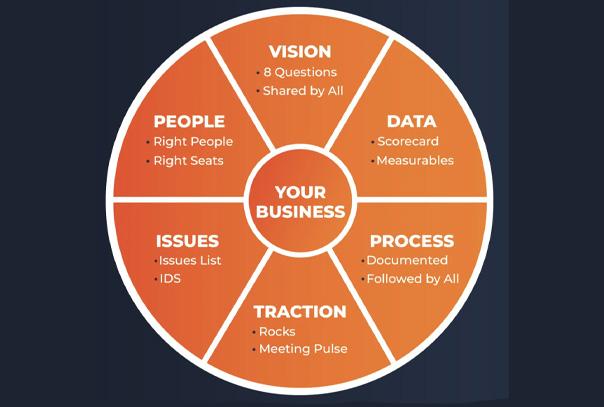
Quite simply, they work hard to strengthen the Six Key Components of their program. Every business, every non-profit, every organization, every program and every team all have some version of the following Six Key Components:
- Vision
- People
- Data
- Issues
- Process
- Traction
The Six Key Components and their associated tools are depicted in the model. Please note that “your business” refers to “your program” or “your team.”
A high-level overview of the Six Key Components of your program:
- Vision: Getting you and your entire team on the same page with where you’re going and how you plan to get there.
- People: Realizing that you cannot achieve a great vision without great people. This component helps identify and develop truly great coaches, players and staff.
- Data: Distilling your entire program down to a handful of numbers that give you the pulse of your team and help you make better decisions.
- Issues: Identifying issues when they arise and solving them forever so you can move on.
- Process: Increasing results without increasing time and effort, giving you more control of your program.
- Traction: Bringing your Vision down to the ground through execution, discipline and accountability. As Gino Wickman says, “Vision without Traction is just hallucination.”
The reality is that you—as the leader and CEO of your program—are accountable for strengthening all six of these components at the same time. This is how you can get more results, a better team and more impact without sacrificing more of your valuable time.
To be clear, this work is difficult. It takes discipline, courage and persistence to strengthen all six of the Key Components. Running your program on EOS is likely a fundamental change to the way you currently run your program today.
The good news is that there are specific tools and disciplines you can use to strengthen each of the components. So give it a shot and reach out if you need any guidance at [email protected].