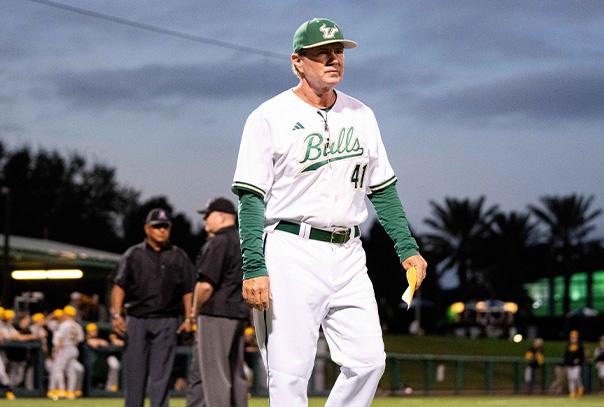
Mitch Hannahs was a 1988 Cape Cod League All-Star and a 1989 ABCA All-American after a senior campaign where he hit .428. He helped Indiana State to 172 wins and three NCAA Tournament appearances across his four years in Terre Haute, and was drafted in the 16th round by the Milwaukee Brewers, advancing to the Double-A level during his three years in the pros.
After his playing career, Hannahs returned as an assistant at ISU before accepting the head job at Lincoln Trail College in 2002, where his team went 21-26 (the only losing season of Hannahs’ career to date). He won a pair of conference championships over nine seasons at LTC and later added athletic director, and ultimately school president, to his duties, the latter being a position that took him off the field (albeit briefly). He eventually got the nod for the head job back at Indiana State in the summer of 2013, and would lead the Sycamores to five NCAA regionals—including four in his last five seasons—and advanced to the 2023 Super Regionals, a program first.
Hannahs notched three 40-win seasons at Indiana State, won back-to-back Missouri Valley Conference titles in 2023 and 2024, and had 14 players taken in MLB Drafts en route to an overall record of 355-214 at ISU. In all, he’s tallied more than 620 wins as a head coach and has a winning percentage of .608.
Inside Pitch: How much was weather a factor in taking the job at South Florida?
Mitch Hannahs: The fall weather is pretty good in Indiana, so it wasn’t awful, but all of us in the Midwest are kind of pushed to get our on-field stuff done early, because you never really know with the weather. There were some things like hitting that we could push indoors or later in the fall. The real struggle in college baseball is once you come back from Thanksgiving break, you probably have a dead week, finals, and Christmas break just like that, so it’s January before you pick back up with them.
The good thing about the Midwest was that we had access to indoor facilities that worked well for us. Here when we have weather, we’re just delayed until we can pick back up, so sometimes it’s an advantage, sometimes it’s a disadvantage.
IP: After establishing such a steady program at Indiana State, what were the challenges of starting anew at USF?
MH: The transition is always more difficult than you expect. Anytime you've been in a place for a while and you feel like you have things running well, it’s hard to pick up and start all over again somewhere else. I recalled a lot of conversations with Brian Smiley from over a decade ago at Indiana State, just with how we were going to attack recruiting and what we wanted our teams to look like moving forward.
IP: How do you attack recruiting?
MH: Our model at ISU was to recruit high school players who we thought could stay in the middle of the field. The idea was that we could develop some continuity in those positions across three or four years instead of one or two. Then we would fill the gaps in the corners on defense or maybe a middle-of-the-order bat with junior college guys.
We tried to get high school starting pitchers and keep them as starters. I’ve seen so many good arms go to other places and get buried in a bullpen because they may never have learned how to get ready quick, work with a shorter leash, or recover well. For that reason, we tried to get junior college bullpen guys who had been relievers and maybe understood what that was like.
Obviously, there were many exceptions, but that was the model we used at Indiana State, and we are taking a similar approach down here at South Florida.
IP: Where do you stand with the portal and balancing your high school commits with junior college and transfer players?
MH: That’s a much tougher decision in the era we’re in. How many high school players should we sign a year? How many JUCO? What should we look for in the portal?
In this demographic, there are a lot of really good high school players, so we don’t hesitate to go after some of those guys and fall back into junior college or the portal if we need to. That’s more or less how we built our first class at USF.
There have been and always will be really talented junior college players. And having been a JUCO coach for 10+ years before I went back to Indiana State, I still highly value the mentality of the junior college player. I think it’s one of the purest forms of baseball—you may start with 40 or 50 guys and all you have to figure out is who loves playing, who’s going to get after it, and you let the chips fall where they may.
IP: How did you like being the president at Lincoln Trail?
MH: At the time, the president was trying to retire, and she was looking for someone they could use to ease that transition. She came to me and asked if I would be the interim president. I said “no” the first couple times. Then the third time, she mentioned how tight money was in the state of Illinois and that there was no guarantee that whoever came in was going to keep athletics. And that worked!
I did it for two-and-a-half years and it was really hard. I talked to my players about getting out of your comfort zone all the time, and that new position taught me that I’d never really been out of mine; athletics was all I knew, and one of the few arenas I’ve always felt comfortable in.
IP: How long before you were looking to get back into coaching?
MH: During that span I did try to get the head job at Indiana State, twice. I didn’t get it either time, which was discouraging. I wanted to provide for my family at a higher level and had actually started looking into other opportunities that were better from a salary standpoint, and the ISU job opened for a third time.
I sent an e-mail to Ron Prettyman, who was the AD at the time. And I was more reserved, not even expecting a response. I just told him I still had a deep passion for Indiana State baseball, and I’d love the opportunity to have that job. But he called, we had a conversation, then we met, and I got that opportunity.
IP: Third time’s a charm with your presidency and the Indiana State job! How were you able to immediately produce winning teams?
MH: We built it, first and foremost, because of the coaching staff we had around during my time there. They were such excellent teachers, and they all really put their heart and soul into it.
IP: What’s your advice to coaches who are taking over new programs and establishing their standards?
MH: If you really want to get down to it and coach in this business, then you must do a great job with the fall. You have to cover ground, push guys, teach, identify, recruit.
We’re ultimately trying to communicate that your “best” is not good enough, but we have a plan to improve it. If we can learn to expect more from ourselves than anyone else, we can truly raise our program’s standard of excellence.