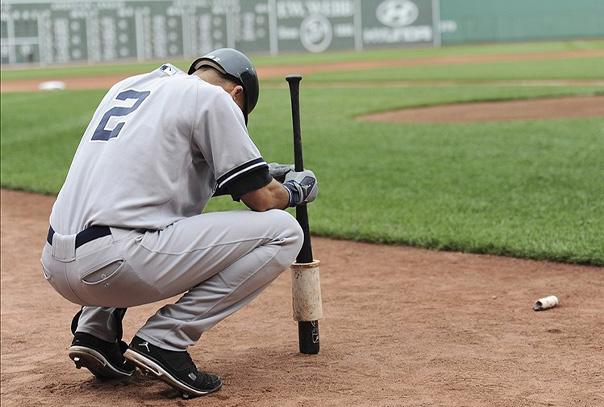
This column is an oxymoron in some ways. You don’t really need to train your mind to focus. I’ve often told clients that a baby can focus without any training. But as simple as focusing on an object in your visual field should be, like many aspects of baseball and life, we overcomplicate and make it harder to keep our eyes on the ball.
I was lucky to learn from the world’s greatest expert on focus and attention, Robert Nideffer, when I was in graduate school. And while I’ve been studying and measuring the way people focus under pressure for 30 years, I feel like I’m learning new ways to explain and teach focus in the last 30 months. Focus Training is a short process that I’ve developed to help athletes practice and improve upon narrowing their focus.
Before we talk about how to improve your focus on an important play, we need to talk about why players need to improve focus on those plays. If you aren’t focused, then where does your mind go? Usually, if you’re not focused at the plate, it’s because you’re thinking about something else. The two most common distracting thoughts are mechanical thoughts and negative thoughts.
If you’re thinking about mechanics instead of trying to see the ball, you’re not going to see the ball as early, and you’re likely going to be late starting your swing. The same is true if you’re thinking a negative or doubtful thought, or really any thought at all.
When you’re thinking, you have an internal focus, so it’s not that you’ve lost all focus, but you have lost your external focus. Your mind is always fixated on something, and that focus is either internal or external and broad or narrow. To hit a baseball, you need a narrow, external focus. To put it more bluntly: you need to see the ball.
When people feel pressure, it’s common for them to try to figure out how to get back to feeling comfortable and confident. That “figuring out” process leads to internal focus (because you’re thinking), and makes it impossible to have the external focus you need to be in the moment.
Focus training is a way to get yourself into the habit of having a narrow and external focus. When you have that narrow/external focus, you can’t be internal as well. You can only be on one focus channel at a time.
So if you’re thinking too much, the good news is that simply using your eyes can get you out of your head. That’s what focus training practices.
To do focus training, start by looking at a small point in front of you. If you’re sitting at a desk or table, look down and find a knot in the wood or a scratch in the surface. Even an all-white countertop will have some scratches or discolorations that you can use for a focal point.
Find your point and take a deep breath. As you exhale, get so focused on your point that you don’t see the rest of the surface around it. This puts you in a narrow/external focus.
Next, you do it again, but with a different focal point. Repeat one more time with a third focal point. After you’ve done three deep breaths and three different points, close your eyes.
When your eyes are closed, you mentally picture yourself at the plate, a pitch being thrown, and you reading and reacting to it. So a right-handed hitter might see a right-handed pitcher throwing a 96-mph, four-seam fastball on the outer half of the plate, seeing it right out of the hand, and hitting it hard into the right-center field gap for a double.
The process should be smooth and continuous: focal point and deep breath one, focal point and deep breath two, focal point and deep breath three, close your eyes, see the pitch and hit it.
Why three different points? I find that most great athletes are so perfectionistic that if you give them the same point three times, they start to evaluate and grade themselves on how well they focused on the point from breath to breath, which reverts them back to thinking internally. Using three different points eliminates that comparing and grading.
Why do the mental practice right after the deep breaths? That’s the trick that makes this all worthwhile. You take three deep breaths to get into the habit of being in a narrow focus and then close your eyes and see yourself being narrowly focused executing your task.
The focus training you did before the mental practice allows your mental imagery to be narrowly focused and specific on what you’re trying to accomplish. And when you get to do the task physically, you’re primed for being in the narrow/external focus you need because you’ve practiced it.
The focal points can be practiced anywhere. Athletes can use points on artwork in hotel rooms, letters on keyboards, sunflower seeds on the dugout floor, or pockmarks in concrete. The key is to pick three different points as you exhale three times, then close your eyes and picture your task.
For example, a third baseman who wants to get rid of the yips—or simply throw more accurately—picks three points, takes three deep breaths, closes his eyes, and sees himself fielding a routine ground ball in the center of his body, executing proper footwork, and making a strong throw to the first baseman’s glove.
You can practice this just about anywhere. It doesn’t need to take more than a few minutes, and it allows you to quickly get back to using your eyes with a narrow focus on your task.
There are many elements of today’s game that make it more nuanced and complicated for coaches and players alike. And there’s no doubt that we could all stand to be more focused at times. Use these methods and give yourself a chance to slow down, reset, and get into an improved frame of mind.
Geoff Miller has spent the better part of two decades working in Major League Baseball for multiple organizations. His mental skills training series and commentary are available through Optimize Mind Performance, an app that links athletes with some of the most renowned mental skills coaches from around the world. For more information, visit www.optimizemindperformance.com.