In baseball, there’s an old saying that rings as true today as it did a century ago: “You play like you practice, and you practice to perfect what you do in the game.” Batting practice has been the heartbeat of player development since the sport’s earliest days. It is a ritual where timing is refined, mechanics are fine-tuned, and confidence is built, one swing at a time.
You could walk into a baseball facility in any era and hear the familiar sound of the crack of the bat as it makes contact with a ball. But how that ball gets to the batter? That keeps evolving.
From Gunpowder to the Iron Mike
Tracking the development of the pitching machine is like tracing a timeline of ingenuity and inventiveness. It begins with Charles Howard Hinton, a mathematics instructor who invented the first known mechanical pitching machine in 1897 while at Princeton University.
Hinton’s original design was powered by compressed air and gunpowder. It wasn’t without its flaws, but it achieved something that had not been accomplished up to that point: it mechanized what had always been a human skill. While crude by today’s standards, Hinton’s design was surprisingly capable as a training tool, throwing at varying speeds. It also helped to establish a principle that remains central to modern training: consistency breeds improvement.
Iterations on Hinton’s design continued over the years, but the real breakthrough came during World War II when mechanical arm designs began to appear in training facilities. It was Paul Giovagnoli’s “Iron Mike” prototype in 1952 that truly revolutionized the space. Giovagnoli, who ran a golf driving range near Topeka, Kansas, wanted to add batting cages to his business.
He developed a machine with a mechanical arm that offered a realistic pitching motion. He called it “Iron Mike,” and it became the gold standard for decades. If you have been to a batting cage, you’ve likely hit off a machine that has Giovagnoli’s design fingerprints on it. Thanks to the Iron Mike, players could, for the first time, face hundreds of pitches in a single session, building muscle memory and timing in ways that were previously impossible during regular practice.
The next major innovation in batting practice came like the first breakthrough, on a college campus. In 1974, police on the Michigan State University campus purchased something novel at the time: a radar gun. The school’s baseball coach, Danny Litwhiler, heard about it and immediately thought he could put it to use. He asked police to see if they could track the speed of baseballs with the gun and figured out that it could provide new insight into the sport.
This marked an early wave of data-driven training. It wasn't just about speed—it was about understanding the measurable differences between pitch types and helping players recognize what they were seeing.
As radar technology evolved, so did training equipment. Machines began incorporating programmable features, giving coaches more options and allowing them to simulate different pitch sequences and locations. Suddenly, a batting practice session could simulate facing three different types of pitchers in succession, each with its own unique characteristics.
The Video Simulator Era
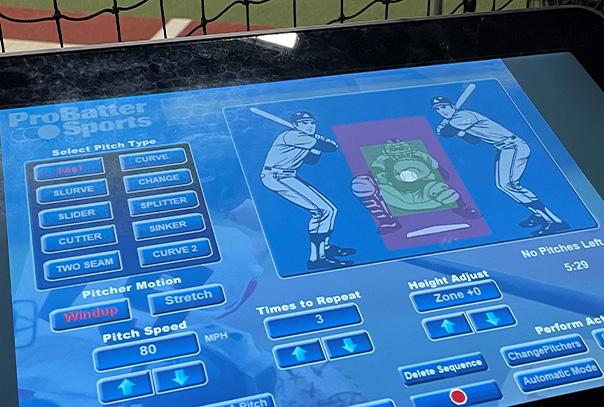
The late 1990s saw another significant advancement in pitching machine technology: the introduction of video simulation. When ProBatter Sports introduced the first video pitching simulator at the Major League Baseball Winter Meetings in 1999, observers realized immediately that the game was about to change.
Video simulators can also address the psychological aspect of hitting. Facing a projection of a real pitcher (complete with wind-up, release point, and ball trajectory) creates a training environment that more closely resembles game conditions. Players can practice facing pitcher tendencies, timing mechanisms, and visual cues that aren’t possible to replicate with mechanical machines alone.
This breakthrough allowed players to experience the visual challenge of facing elite pitching and the physical challenge of making contact with precisely thrown balls. A high school player anywhere in the country can now practice against Gerrit Cole’s four-seamer or Paul Skenes’ sinker, gaining exposure to pitch types and velocities they might not encounter in their local competition.
Modern Simulators
Today’s most advanced systems represent a convergence of mechanical precision and data analytics that continue to transform how we understand player development. ProBatter has installed more than 600 simulators throughout the United States and in eight international countries, creating a network of standardized training environments where performance data can be collected and analyzed across different locations and skill levels.
Modern pitching simulators can track metrics like exit velocity, launch angle, contact point, and swing path, providing instant feedback that allows players to make real-time adjustments. This data loop accelerates learning in ways that traditional coaching methods alone cannot achieve.
Players can see exactly how small adjustments in stance or timing affect their results, making abstract coaching concepts tangible and measurable, turning every swing into actionable intelligence. Coaches can identify patterns in a player’s approach, track improvement over time, and design specific drills to address weaknesses revealed by the data.
Scouting in the Digital Age
The data revolution has also transformed how scouts evaluate talent. Traditional scouting relied heavily on live observation and subjective assessment, but modern training technology provides objective measurements that complement seasoned eyes.
This data-driven approach is particularly valuable for evaluating players who might not have access to high-level competition. A talented player in a smaller market can demonstrate their ability to handle elite-level pitching through simulator training, providing scouts with measurable evidence of their potential.
The consistency of simulator training also creates standardized conditions for player comparison. When multiple prospects train on similar systems, their data becomes directly comparable, allowing scouts to make more informed decisions about player rankings and potential.
Personalized Training Protocols
Modern pitching machine technology is all about the move toward truly personalized training experiences. We’ll see machines that can adapt pitch selection based on a player’s performance history, creating training sessions that automatically adjust difficulty and focus areas in response to real-time results.
For example, if a player struggles with breaking balls low in the zone, the system can automatically increase the frequency of those pitches while providing specific feedback on swing adjustments. This targeted feedback maximizes the efficiency of practice time.
Personalization can extend beyond just pitch selection as well. Modern systems can adjust to create specific game situations to help hone a player’s approach. Players can practice hitting with runners in scoring position, work on two-strike at-bats, or prepare for specific opposing pitchers they’ll face.
The evolution from Hinton’s gunpowder-powered contraption to today’s data-rich video simulators is a fundamental shift in how we approach player development. Training is no longer about simply taking swings. It’s about making each one of those swings productive and building on a player’s skills with intelligence.