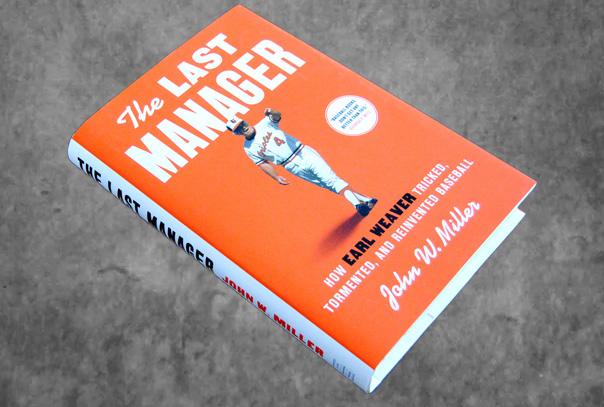
Baseball fans know Earl Weaver as the epitome of the ranting, raving baseball manager who lives forever in YouTube videos of fights with umpires—but he was also a great baseball teacher and leader. A great coach.
When my biography of Earl, The Last Manager: How Earl Weaver Tricked, Tormented and Reinvented Baseball, landed on the New York Times bestseller list this spring, it was mostly because I’d dug up fresh material about Weaver’s hardscrabble background in 1930s St. Louis, his brilliant early minor league playing career, and his apprenticeship at the knee of his uncle, who was a bookie in the St. Louis mob. I was able to report and research the story because I’ve had a 25-year career as a professional journalist and writer, including 13 years as a staff reporter at the Wall Street Journal.
If you ask me, however, the subject I uncovered that interested me the most was what I was able to dig up about Weaver from my vantage point as a baseball coach. I’m an ABCA member and have done all kinds of part-time jobs in baseball, from Little League commissioner to MLB scout. I’m currently the head varsity coach at Allderdice High School, the city of Pittsburgh’s biggest public high school. In my first season, we went 14-7 after going 6-36 the previous three seasons.
A big reason was some of the coaching methods I learned in reporting and writing my book.
Educated baseball fans know that Earl Weaver was famous for preaching “pitching, defense and three-run homers.” But there was a lot more to it than that. From his childhood, Earl Weaver learned a brand of solid, fundamental baseball.
I tracked down Pat Elliott, the son of Ray Elliott, Earl’s coach at Beaumont High School in St. Louis. In seventeen seasons, Coach Elliott won 308 games and lost 138, for a .691 winning percentage, and coached 54 future pros, including seven big leaguers, such as All-Stars Roy Sievers and Bobby Hofman. They played on the same American Legion team as another St. Louis kid, Lawrence Berra, who was nicknamed shortly thereafter for the cross-legged way he sat...“Yogi.”
Luckily for me, Pat still had practice plans in his archives from his dad. Coach Elliott, it turned out, was obsessed with strike-throwing. He rigged up strike zones with strings tied between volleyball poles, made pitchers throw at the targets “until their fingers bled,” and kept a notebook where he collected data on how many strikes each pitcher threw at practice. Only the top performers would earn assignments in games.
In Elliott’s view, teaching young men to win baseball games required—more than any special strategy or trick plays—setting their sights on executing tasks (such as throwing strikes), making all routine defensive plays, and putting pressure on defenses with plate discipline and hard contact. Elliott never let up. During St. Louis winters, he organized indoor practices with tennis balls in the school gym, a rare exercise at the time, and invented drills to improve the team’s fundamentals. In the coach’s version of “pepper,” the fielders stood 60 feet away and threw hard strikes. Elliott called it “long-distance pepper.”
After Weaver joined the Orioles, a big part of his job was to design “The Oriole Way.” To do so, he borrowed a lot of Coach Elliott’s principles. Intended for every player and team in the organization, The Oriole Way covered every facet of the game, from pitching to clubhouse rules. Big league teams had circulated manuals and memos about the right way to play baseball throughout the 1950s and 1960s. What distinguished the Orioles’ approach was its thoroughness and—after Weaver took over—the club’s dedication to actually implementing and enforcing the philosophy.
Every detail mattered. For example: “When a pitcher releases the ball, he is no longer a pitcher but now another infielder and ready to make all the plays. [When covering first], the pitcher should not snatch at ball. Don’t fight it. Be relaxed when fielding this tossed ball.”
The Oriole Way offered 56 specific, individual teaching points for each infielder, including:
- Foot spread depends upon most comfortable position for individual infielder (not too wide).
- Have relaxed hands. Do not jab or be stiff with glove.
- Infielders must establish his weak and strong side. He then must lean towards the side he doesn’t do as well, until this is improved.
- Don’t just throw for the sake of warming up. Throw for improved accuracy.
Weaver’s manifesto preached a simple approach for pitching: don’t fool around, pound the strike zone with your best two or three pitches, change speeds, and let the defense do their job. Weaver picked good pitchers, gave them massive amounts of innings, and kept them “healthy” (or pushed them to pitch hurt).
Most pitchers, coaches, and managers are afraid to embrace a strategy of bluntly keeping pitches over the plate, because they’re afraid of getting hit hard. Not Weaver, who preached changing speeds over precise location, and trusted his defense.
Weaver harassed and ruthlessly demoted pitchers who didn’t throw strikes. As he put it: “If you don’t get the ball over the plate, the batters will keep walking around and stepping on it.” The 1971 Orioles finished second in the big leagues in ERA, but only twentieth out of twenty-four teams in strikeouts. Between 1969 and 1982, the Orioles finished first in the American League in ERA at 3.30, but tenth in the league in strikeouts per nine innings.
After researching Weaver’s approach and philosophy, I personally abandoned the usual coach talk to pitchers about “hitting spots.” Instead, I told our pitchers at Allderdice to make sure they were over the plate, but don’t throw the same pitch (to the same spot) twice in a row. I made the changeup central to our program. We made everybody play catch with changeups as part of our throwing program. And it worked—we cut our walk rate in half, and improved our team ERA to 2.67 from 8.54.
In one of my chapters, I examined how Weaver, who had a drinking problem, could still be a great baseball leader despite having such a messy personal life. The answer, I think, is that he had such a clear vision of the mechanics and rhythms of baseball. Weaver liked to say that many coaches made baseball too complicated. Baseball, he said, “is common sense.” It’s a mentality that is hopefully familiar to most high school and college coaches—throw strikes, make routine plays, sprint off the field, have good at-bats.
Hopefully none of us go as far as Earl did with our outbursts, but I am sure that most all baseball coaches still have them from time to time (or at least feel like having them). When that happens, it’s important to remember the lesser-known part of Earl Weaver’s legacy—the coaching. Keep it simple!