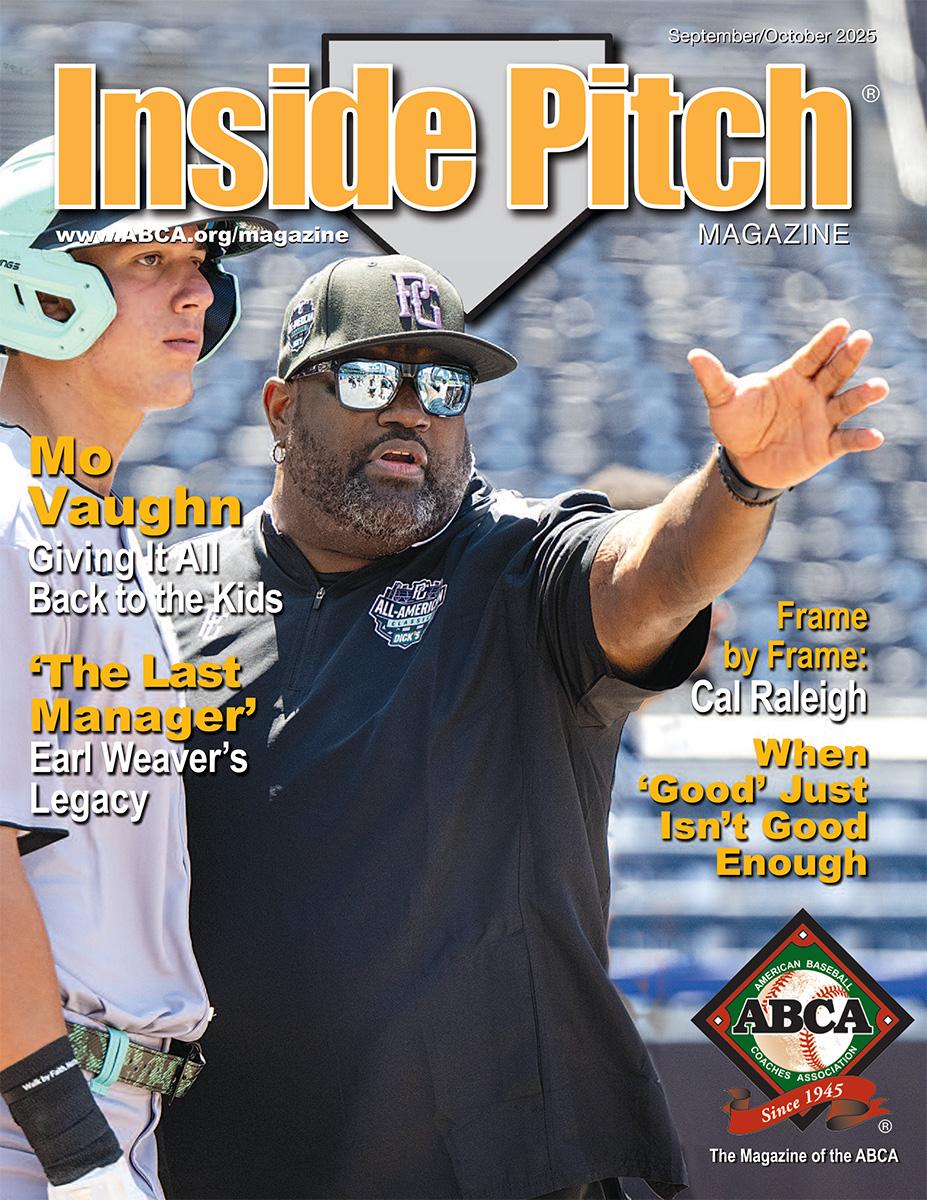
Former major league All-Star and American League MVP Mo Vaughn is making an indelible impact on the world of amateur baseball through Vaughn Sports Academy. Named after his father and established just over a decade ago in 2015, VSA is now home to around 2,000 members and 100 teams. Still widely known as the “Hit Dog” for his presence and accolades at the plate, Vaughn is also a Special Assistant to Perfect Game ownership, where he assists in identifying youth baseball talent in parts of the country where the socioeconomic status may prevent opportunity.
Inside Pitch: When did you decide it was time to return to the game after you retired as a player?
MV: When I left the game, I felt like I needed to do something different. I got into the real estate business and wasn’t involved in the game at all. When my son started playing, we ended up doing a season of tee ball in Florida and it felt like we got rained out every day of the season! We couldn’t get out on the field and play, which was too bad for the kids—there weren’t any chances for them to get out on the field and practice, which really wasn’t a good feeling for me. That’s when we started to form the [Vaughn Sports] Academy.
We called it the PawSox at first after Boston’s Triple-A team, which I enjoyed playing for. But then they moved to Worcester so they did the “WooSox” and I didn’t really like that name, so we moved over to the Vaughn Sports Academy, named after my dad. It’s been a slow progression, but we’ve got hitting, defense, catching, and pitching on one side, and strength and conditioning, red light therapy, a sauna with a cold plunge for that training room/weight room environment on the other side. Our vision is to be a one-stop shop for all baseball needs, regardless of playing level.
IP: Did you ever really feel like you were destined to be a coach?
MV: I thought my greatest accomplishment may have been as a player on the field, or maybe with the real estate projects and the affordable housing businesses. And Greg Casterioto and I have started on MVP: The Mo Vaughn Podcast, which is also a lot of fun. At first that was challenging—it can be tough for some of us older guys because we had to learn how not to give bulletin board material in front of microphones. And we learned it the hard way sometimes! But I really enjoy it—it’s therapeutic to talk about the game in an open forum that way, and reconnect with some old buddies and former teammates.
But then I got challenged to get back on to the field and actually start coaching hitting, and that’s helped me learn that what I really am is a coach. After all that life experience, this is my true calling. That’s a big reason why developing our team model with VSA has been so much fun, because it got me back on the field.
IP: What’s your philosophy as a hitting coach?
MV: I’m just trying to help our players navigate the batter’s box, which we all know creates a tremendous amount of anxiety at every level you play. How I felt when I first went up and down [from Triple-A to the big leagues] a few times resulted in anxiety, stress, depression, the unknown. We are trying to take those things away so you can walk to the plate with some confidence. If you arm your kids with that type of ability as a coach, they can improve quickly. That’s where I have the biggest edge as a coach, because I can go back to my experiences when I talk about approach, or adjustments, or hitting in general.
IP: Any other keys to being a good coach?
MV: The first thing any good coach needs is humility. You need to keep learning how to see things different ways, how to figure out what works best for each player. I never forgot how hard this game is. Once you can embrace that, you can become a decent coach.
And I still believe there’s only one way to play the game. I’m not sure all these other analytics should be at the forefront. It’s understandable with the science and the technology, but we are just trying to find ways to simplify the process of lowering the anxiety when you walk up to the plate.
IP: How was your experience as a youth coach?
MV: I got to coach my son when he was seven. With those ages, you have about 20 minutes. After that, attention span: gone. Learning how to impact my son in such a short amount of time was a challenge, because as a coach you know it’s a long-haul development process. And I used to worry, man, trying to find ways to keep hitting when that swing is right, the fear of missing out when we take time off. But you learn not to stress about things like that.
You need to capitalize during games too, as a coach. We get a tremendous opportunity to play this game on some great platforms with Perfect Game. Practice is important as well, of course, along with teaching, but understanding what your players are doing in the competitive moment and making sure they understand is another piece that is vital in youth coaching
IP: Let’s talk about how good your teams were at Seton Hall.
MV: We had a Hall of Famer in (Craig) Biggio, myself, John Valentin and Kevin Morton in 1988. We had all those major leaguers, we had great coaching and leadership, and honestly, our best player was Marteese Robinson, who was named the NCAA National Co-Player of the Year in 1987. He led the country with a .529 average, stole 56 bases and drove in 90 runs! Biggio hit .407 that year with 14 jacks, 68 RBIs and 30 stolen bases as a catcher, and I hit .429 with 28 jacks and 90 RBIs. And we had Dana Brown as our leadoff hitter, who’s now the General Manager of the Houston Astros.
In the fall, we would play games the coaches didn’t even come to. Biggio and Vinny (Vic) DiPasquale drove the bus, we used instincts instead of base coaches, and we still beat everyone. But we really did have great leadership, and that started with our coaches. I learned to play the game under coach Mike Sheppard, Sr. and Ed Blankmeyer. We had a talented group but once we learned that system, we were unstoppable.
We went 45-10 in 1987 and went all the way to the third round of the regionals. We lost to Frank Thomas’ Auburn team. I remember none of us had ever seen a curveball like Gregg Olson’s. But a lot of my development process as a player was in college. I learned so much and was able to apply most everything those coaches taught me to every level of my career.
IP: How did you learn your batting stance?
MV: I learned my stance from Mike Easler, who noted how off-balance I was in 1993. He helped me fix my swing in two weeks at spring training, every morning at 7 AM, one hour a day. We found out that I could basically stand flat-footed, barely stride and still retain most of my power. This gave me a much better chance to see the ball and go the other way with the same power, which I really needed to learn how to do with the Green Monster at Fenway. But my son or some of my other guys will see my old video and do the imitation thing, which is flattering and all, but I make sure they get back to being their own guys pretty quickly.
IP: I hear you have an interesting elbow guard origin story.
MV: That all started in Boston. First one I got was from [Boston Bruin great] Cam Neely. Part of the perks I had in Boston was I could drive up to the [Boston] Garden, they’d valet my car, and I got to sit at the press desk and watch Bird, Parrish, and McHale with the Celtics, and the Bruins like it was my living room. I swear Cam Neely would score a hat trick every time I saw them play. We were all together with the Boston sports community like no place I’ve ever been.
IP: How about some advice to youth players and their families?
MV: Connect with someone to teach you the nuances of the game—rundowns, relays, bunt plays, how to run the bases— the little things. You can’t expect every rec coach or even your travel coaches to be able to cover it all. The main thing you need to learn from your on-field coaches is how to play for a team. There’s nothing wrong with going to showcases just to check in on your latest numbers on a platform where you must perform under some pressure, in front of your peers and some scouts. Plus the kids can get a lot out of learning what their true strengths are and how to literally “showcase” them on the field. That’s how you want to play the game, use your best tools to help your team win the game.
Learn teamwork. It’s got to be about us, and again that takes humility. Like we talked about before, learn what your tools are, learn how to use them to help your team win, and learn how to improve your worst tools so they aren’t the reason you lose. Work on your own, learn on your own, learn how to watch baseball. Get on some speed and conditioning or strength and conditioning programs as you grow. Learn how to work out and how to get good at working out. You can’t learn work ethic any other way than to work.
MVP: The Mo Vaughn Podcast debuts new episodes every Thursday at 5 a.m. ET on Spotify, Apple Podcasts, Google Play and all major podcast platforms. Episodes will debut on Mo Vaughn’s YouTube channel at noon and air at 7 p.m. ET on PerfectGame.TV and on the free PGTV app.