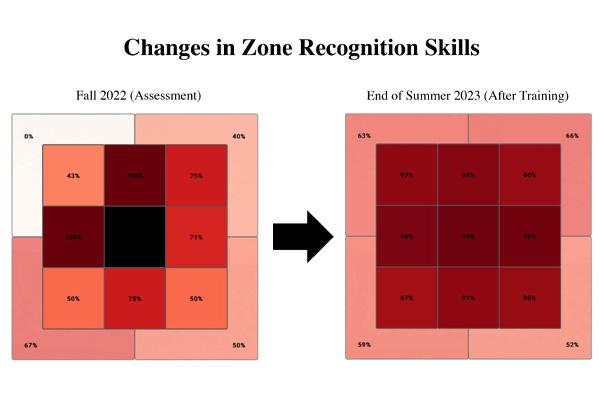
After years of research, planning and preparation, Cody Atkinson and Dr. Jason Sherwin Ph.D. rolled out a visual decision training program across parts of the Texas Rangers’ minor league system. At the heart of the program was “uHIT Baseball,” a neuroscience-based app developed by Sherwin and deCervo, a company he co-founded. The app, which offers pitch and zone recognition training personalized for each hitter, was implemented and reviewed remotely, with both players and coaches.
Over two seasons, they observed measurable improvements in decision-making and in-game performance, along with the effectiveness of vision training across varying levels of integration. In this article, submitted by Atkinson and Sherwin, they present the key outcomes, challenges, and lessons learned from their ongoing project.
Evaluating Pitch and Zone Skills
The uHIT Baseball app begins with a standardized assessment of a hitter’s pitch and zone recognition abilities. Each hitter completes a series of 120 pitches, balanced between both left- and right-handed pitchers, for two core objectives. The first is to find out the player’s current Pitch Recognition capacity, or the ability to identify pitch types (e.g., fastball, slider, curveball) in a go/no-go format. The second objective is to discover their Zone Recognition; simply put, identifying balls vs. strikes.
Decisions are made under realistic time pressure, and performance is scored using “XP” (experience points), based on decision speed and accuracy. Accurate, fast decisions earn more XP, while poor or slow decisions reduce the score.
Among the Minor League hitters we evaluated—which included players from newly drafted signees through Double-A level—the average results were a 67% accuracy in Zone Recognition, with an average score of 43 XP/pitch, and 53% Pitch Recognition, good for 15 XP/pitch.
These scores aren’t necessarily meant to project Major League potential, but rather establish a cognitive baseline for the hitter’s training progression. For example, we learned that the hitters who generated those scores were generally more adept at identifying balls and strikes than they were pitch types. In fact, their 53% average in pitch recognition suggests hitters were often guessing (50% = random as a coin flip).
Training Pitch and Zone Skills
Once our training began, we personalized each hitter’s uHIT experience to match their current skill level, adjusting pitch speeds, movement, and proximity to the strike zone. Through ongoing virtual meetings with coaches and players, we reviewed app performance and connected those metrics to on-field outcomes like OPS and swing decisions during practice and games.
We used in-app XP and Accuracy data alongside traditional statistics to monitor progress. A key question from coaches was: “Does this training actually improve game performance, or just app performance?” The answer lies in the consistent correlations we observed between improved uHIT performance and on-field results.
Hitter #1: A Rapid Rise Through Targeted Training
This hitter began with above-average metrics:
- Zone Recognition: 68% Accuracy, 35 XP/pitch
- Pitch Recognition: 61% Accuracy, 38 XP/pitch
However, his assessments revealed specific blind spots—he chased up-and-in pitches and was overly aggressive in certain zones. He also had difficulty resisting curveballs he misread.
After one fall and one full spring/summer of training:
- Zone Recognition: 81% Accuracy, 93 XP/pitch
- Pitch Recognition: 75% Accuracy, 75 XP/pitch
His zone accuracy became more uniform, eliminating obvious weak zones. In 2022, he posted a .621 OPS in the Dominican Summer League (112 ABs). After training, his 2023 OPS rose to 1.075 (54 ABs), before being traded for a Major League pitcher. His slugging percentage increased 95%, while OBP rose 33%, suggesting better pitch selection and more power contact in his hot zones.
Hitter #2: The Importance of Coaching Support
Hitter #2 was a 2023 draftee who completed the uHIT assessment but struggled to train consistently without coaching guidance:
- Zone Recognition: 59% Accuracy, 48 XP/pitch
- Pitch Recognition: 50% Accuracy, 17 XP/pitch
His performance seemed adequate at surface level: .704 OPS in DSL (31 ABs), .849 OPS in the ACL (143 ABs), and .544 OPS in High A (13 ABs). But SO/BB ratios revealed deeper issues. His strikeout-to-walk ratio ballooned from 0.8 (DSL) to 5.1 (ACL), with a 38% K rate in High A. These trends warned of looming struggles at higher levels.
With increased involvement from hitting staff and even his parent, Hitter #2 received structured, individualized support from January to May 2024. By the end of that stretch:
- Zone Recognition: 75% Accuracy, 85 XP/pitch
- Pitch Recognition: 67% Accuracy, 66 XP/pitch
His accuracy in recognizing expected pitch types improved, as did his impulse control on unexpected ones. In 2024, his High A OPS rose to .785 across 433 ABs, and he struck out 10% less per AB than in 2023. Most notably, he posted a .984 OPS in a late-season promotion to Double-A.
Lessons for Coaches
Our experience over five years, across multiple levels of professional baseball, led to several important takeaways:
- Vision and decision training must be integrated into coaching. Hitters won’t develop these skills on their own. Just like swing mechanics, pitch recognition needs guided development.
- 1-on-1 feedback is essential. The uHIT app offers powerful tools, but its full value is unlocked when coaches help hitters understand what their metrics mean and how they translate to game performance.
- Consistency and support matter. As with any skill, hitters progress best with routine, structure, and accountability—whether from coaches or family.
- These techniques scale to college and high school. While our focus was professional players, the cognitive challenges of pitch recognition are universal. High school and college hitters can benefit similarly.
From our initial collaboration in 2019 to Fall 2024, we’ve proven that neuroscience can be practically and successfully integrated into hitter development. This isn’t about futuristic technology—it’s about real, individualized coaching using tools rooted in cognitive science. When properly implemented, vision and decision training improves performance not only in the app, but more importantly, in the batter’s box.