America’s favorite pastime is said to have been founded by Abner Doubleday in 1839 in Cooperstown, New York, the current home of the National Baseball Hall of Fame. However, some research suggests baseball evolved from earlier activities such as the English game Rounders.
Regardless of its origin, baseball has morphed and spread across the globe, thanks to its perfect combination of individual brilliance, team strategy, unpredictability, and timeless appeal that we’ve all come to love. The game’s intricate rules, unique field, and long history create a unique and captivating experience for observers and players, who represent a kaleidoscope of the shapes, sizes, colors, and cultures of our world. America’s game? Perhaps, but it would appear today that baseball is the world’s game.
Japan, South Korea, Taiwan and Latin American countries have developed their own unique cultures and brands of play. Baseball is even beginning to flourish in Africa, as camps, clinics and tournaments in even the most remote parts of the continent occur on a frequent basis.
Editor’s note: Check out the article from our September/October 2023 issue titled Building Two-Strike Hitting Skills for the Developing (International) Player for a closer look at what ABCA member Brian Covell is doing in Benin, West Africa.
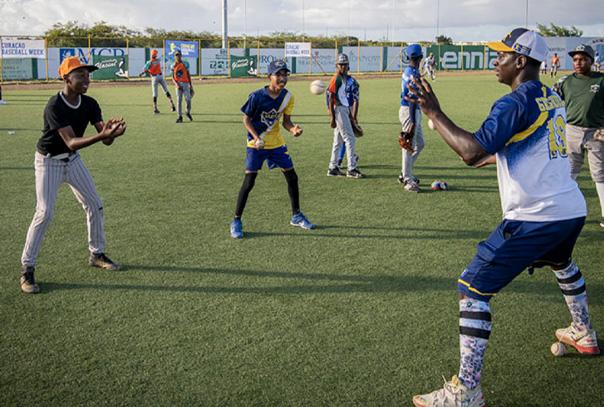
Perhaps the most fascinating incubator where baseball has flourished is Curaçao. A tiny island off the coast of Venezuela, Curaçao produces more Major League Baseball players per capita than any other piece of real estate on the planet. Hensley “Bam Bam” Meulens [Note: “Bam Bam” was one of our favorite interviews, from our Summer 2015 issue] was the first, followed by Andruw Jones, Ozzie Albies, Kenley Jansen, Jurickson Profar, Jonathan Schoop and Didi Gregorius to name just a few, all from a country with a smaller population than Pomona, California and Olathe, Kansas.
Albies recently recalled that during his youth, he would take ground ball after ground ball on the rocky and glass-sharded surface of his “home field” in Dushi Korsou. Albies noted with a smile, “It taught me how to catch a groundball!” Curaçao’s “Baseball Week,” held the first week of each January, rivals any event of its kind in the world, as it serves as a glimpse into the future to see who will be next to be “on-deck” to play in the MLB (visit curaçaobaseballweek.com).
But what about baseball roots in Germany? How about George Herman Ruth, aka “The Babe,” who was born of German descent? His maternal grandfather Pius Schamberger is quoted as saying, “Baseball was, is and always will be to me the best game in the world.” The first official baseball game in Germany was played at the 1936 Berlin Olympics, and after World War II, baseball was popularized by American soldiers stationed in Germany.
One graduate of the German baseball process is Maximilian Kepler-Różycki, better known as Philadelphia Phillies outfielder Max Kepler, who was born in Berlin to professional ballet dancers. Kepler declined a scholarship to the Steffi Graf Tennis Foundation at age seven and played baseball at the John F. Kennedy School, St. Emmeram Academy in Regensberg, and for the Buchbinder Legionäre before signing with the Minnesota Twins at age 16.
Since sports programs are not typically associated with schools and universities throughout Europe, clubs have assimilated to promote the sport of choice. When one thinks of a sports “club” in Europe, football (soccer) comes to mind, but there are some baseball clubs in Germany and throughout Europe that are structured in similar fashion, with various levels of teams, leagues, attention and so forth, complete with relegation awaiting clubs that no longer have what it takes to stay at their current level of competition. These teams belong to the fans and countless volunteers who fuel the progress, development and growth of their respective clubs.
To better understand the “club” structure, FC Bayern Munich was founded on February 27, 1900, at Café Gisela in Munich. What started with only a few has become one of the largest clubs—of any kind—on the planet today. FC Bayern München has more than 400,000 members! Through their membership, these supporters/fans not only document their identification with the club but are also part of the larger FC Bayern family...the community. The Solingen Alligators Baseball Club, established in 1991, has already become one of Germany’s largest and most successful baseball clubs.
Today, what started with only a few passionate souls in a small German town in 1991 is growing exponentially, as more and more baseball purists throughout the North Rhine-Westphalia region of Germany and the world are jumping on board the Alligators’ bandwagon and becoming club members. Since their inception, in addition to two German National Championships to their credit, the ’Gators have produced top-end talent like Kai Gronauer, who reached the triple-A level with the New York Mets, and Lars Anderson, a former Red Sox top prospect who reached the big leagues at age 22.
Their expanding media network includes their podcast “The Swamp” (home field of ’Gators, located at Solingen’s Weyersberg Sportsplatz). This innovative forum features former MLB legends of the game such as Meulens, Willie Aikens, Derrick May, Mark Leiter and current MLB coaches that include Kai Correa and Ryan Sienko. Podcasts from The Swamp can be found on YouTube and Spotify.
Alligators’ management is committed to bringing their game to every baseball fan they can reach, regardless of where they are in the world. Virtual fans from the Pacific Rim to Central and South America and even the United States can dial in to watch a unique brand of baseball and a developing movement.
Baseball is booming in Germany and throughout Europe, thanks to an ever-improving level of competitive play along with a new wave of support from its communities. Its fields are slowly developing into ballparks, places for people to come together, celebrate their differences and cheer for their home team, their home community. While it won’t ever be the next Curaçao, over time, the biggest difference between baseball in Germany and the United States may just be beer and brats in lieu of peanuts and Cracker Jacks.