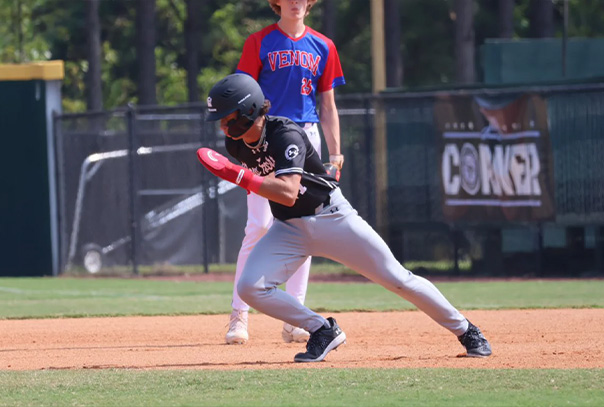
I absolutely love baserunning. Always have, always will. The thing about baserunning is that it is one of the game’s underappreciated skills and a weapon for players and teams alike to use as a competitive advantage. And it will always shock me how few players and teams actually take advantage of it.
Part of the reason why most don’t run the bases well is because there is a misnomer about baserunning; most think it is all about speed and stealing bases, which is actually only one part of the many parts of baserunning that can change a game. The common thought is that if you don’t have speed, then you can’t have an impact on the bases. That couldn’t be further from the truth. Yes, it helps to be fast—no one will deny that. But the skill is way more about details and decisions than it is about being fast. All speed does is allow someone to outrun a bad decision or overcome a lack of attention to detail.
Most players aren’t fast enough to outrun those bad decisions and derailed details. That’s when frustrated coaches start to ask questions like this:
“What the heck was he thinking to run into that out there? The ground ball was right in front of him!”
Or: “How did he not advance to third base on that hit? Even I could have made it!”
The real question should be directed right back at the coach: how often have you spent time actually teaching baserunning so those mistakes wouldn’t be made? How have you made an effort to create the buy-in with your players for a part of the game that most couldn’t care less about?
How do you create a buy-in to care about a part of the game that few truly care about? You make it important by spending some of your valuable and limited practice time on it. Whether it be with baserunning or anything else, I promise you, players will care about the things their coaches care about and invest time in. You teach it. You talk about it. You celebrate it. It’s not easy, but it is absolutely achievable.
Here are a few surefire ways to—at worst—elevate your players’ awareness to the importance of running the bases well, and—at best—create a culture where everyone takes pride in winning games because of their ability to run the bases well.
Start every day with baserunning before your players even pick up a ball.
In 2019, I took over as the Red Sox outfield and baserunning coordinator, charged with leading the entire organization’s developmental approach in both areas. When our field coordinator called to discuss scheduling for Spring Training, I had just one simple request: 10-15 minutes at the start of each day to teach some element of baserunning to the entire camp. He asked “why at the start, when I could have fit it into the day elsewhere?”
My rationale was simple and two-fold. First, by having it as the very first activity of the day on the field, it showed our players how important it was to us as an organization that we were working on baserunning before we touched a bat, glove, or ball. Second, our players’ attention span was at its height at the beginning of the day, so whatever we decided to do first had the best chance to stick. Don’t worry, they will always have attention to hit, so it’s ok to keep that last!
Bonus reason to start the day with baserunning: it becomes an extension of the warm-up or a functional form of conditioning that will get guys primed for their day even more.
Coach baserunning practice during batting practice.
Whether it be defense or baserunning, live reads during BP will always be the best practice reps your players can possibly get. But to get even more out of those reads on the bases, you actually have to coach them out of your players. Without someone standing next to them hawking on every rep and watching things like primary lead distance, secondary technique and timing, reads, or breaks, the reality is that the focus won’t be there without the coach right there with them. When the coach is there every day, the concentration and attention to detail is elevated in practice, which means the reads will be better executed in games.
Link a baserunning play to a run or a win or a title!
As you may recall, the Red Sox won the World Series in 2018, and as part of my introduction into my new role leading our baserunning efforts the following year, I used game one of the fall classic as a way to get our players to view baserunning in the same light they did hitting and defense: as a skill that they can develop to help us win games.
In the first inning of the game, Mookie Betts reached base on a single and immediately stole second. He would then score (because of that baserunning play) on Andrew Benintendi’s base hit, who advanced to second on a high throw to the plate (another baserunning play) and would later score on a J.D. Martinez single. Red Sox 2, Dodgers 0…with both runs scoring because of two baserunning plays.
Fast forward to the bottom of the third with the game tied at two. World Series MVP Steve Pearce ran hard down the line to beat out a potential inning-ending double play. Because the inning continued, Martinez stepped to the plate and hit a double that drove Pearce in from first. Pearce’s effort on the bases created the Red Sox’s third run of the game. The game was tied again in the fifth when Xander Bogaerts—like Pearce—gave his best effort to beat out another potential inning-ending double play ground ball, enabling a run to score on the play and allowing the inning to continue. Rafael Devers was the next hitter, and he singled home another run.
When the dust settled after five innings, the Red Sox led by a score of 5-3, with all five runs directly linked to baserunning. When our players realized that baserunning played a huge part in us winning the World Series, all of a sudden the skill took on a greater importance to them because they saw how it directly impacted our championship. That gave them a clear vision to understand why it was so important, despite them just hearing that it was for years.
With just a little time, creativity, and organizational skills, you can be one of the few who turns baserunning into the game-changing weapon that it truly should be for all.