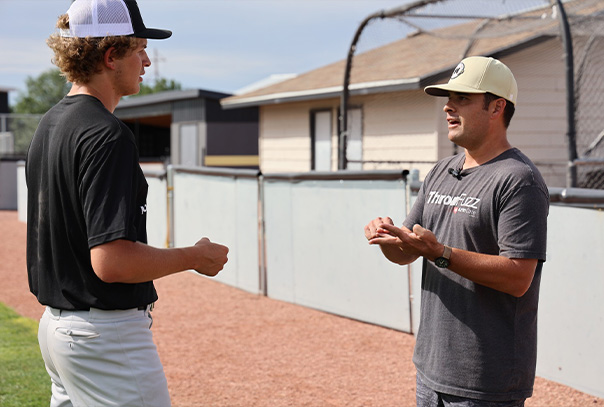
Jordan Oseguera accepted his current role as the Director of Pitching with ArmCare.com after working for six years in the Angels organization in multiple roles, including pitching analyst, affiliate coach, and programs coordinator, spending time on the field and in the lab as well as the draft room. Oseguera spent eight years as an assistant coach at Vanguard University (CA) and coached for a year at Calvary Chapel (CA) High School. He played collegiate ball at Vanguard and the College of Southern Idaho and professionally for the Tijuana Cimarrones (Golden League) and the Ruidoso Osos (Pecos League).
IP: What were your roles with the Angels like?
JO: I was brought into a unique role where I worked at the affiliate level, traveled extensively, and evaluated all the pitchers in the draft. I was on a team that helped put together our pitching development model, with our number one objective being to reduce injuries through biomechanics, and while that continues to be a great challenge, we were actually able to improve performance. Andrew Heaney had a solid run for us, along with Garrett Richards and others, and of course, we were lucky enough to be there with Shohei Ohtani.
IP: I remember he arrived to you with an already-damaged UCL. How did you manage to get him through 10 starts with relative success (3.31 ERA, 63/22 K/BB, 38 hits allowed in 51.2 innings)?
JO: We had our work cut out for us, for sure. There was always a lot going on, and we were just trying to keep him as healthy as we could for that first year. Billy Eppler gave us the proverbial “keys” to determine what needed to be done. He and Steve Martone put their trust in us and supported us, I can’t say enough positive things about those two guys. But Shohei had a tough time returning from Tommy John surgery. He had a really rough spring training—there were a lot of adjustments he ended up making so he could get healthy. In the grand scheme of things, he made them really quickly. It’s just so hard to stay intact when you’re throwing upwards of 100 mph.
IP: No doubt. How did you end up transitioning from the Angels?
JO: My mentor, since I can remember, has been Tom House. For whatever reason, he’s been really kind to me; he’s taken me and so many others under his wing and taught us every step along the way, which I’m so very grateful for. Tom helped me learn how to “do numbers,” analytics, and all these other things.
And with the Angels I crossed paths with Ryan Crotin [Executive Vice President, ArmCare.com], who’s got a Ph.D. We teamed up with Andrew Hawkins, one of the best PT’s I’ve ever come across. Andrew now works with the military doing a lot of cool stuff rehabbing our soldiers. But we all started looking at the strength data from what the arm can do, who got better in our programs, who got worse, and who got hurt. We were able to take all that data and pick out the guys who got to the big leagues and were pure experiments, 40th rounders, injured guys, guys who lost their stuff and got released. We got them back throwing hard using the data and understanding how to massage that into a training plan on the strength side, or a weighted ball plan, or a throwing program, or a pitch development plan, just maximizing whatever it is they were doing.
We’re called ArmCare, but we’ve found that if you improve specific data points, we’re going to throw the ball harder almost a hundred percent of the time.
IP: And this all ties in with Crossover Symmetry as well?
JO: Yes, that’s the second big thing. Duggan Moran, the founder of Crossover Symmetry, was a pitcher with arm problems, and his dad was a physical therapist. They ultimately created Crossover as a result, and Duggan ended up recovering well enough to make it to the pros, pretty cool story. So as we started getting the shoulder balanced a little differently from what traditional research was saying, we saw both velocity bumps and Newton meters of force on the elbow go down. So it’s “fixing” the arm, getting it stronger, getting it balanced, and then turning them loose. From there we dove into, “if this is what’s going on with the arm, what else might be sending us in the wrong direction?” Basically, ArmCare is the individualized version of Crossover; it’s going to give you the shoulder work, bicep, tricep, lats, plyometrics, hip and core system.
IP: And you’re also able to determine pitch counts with this data?
JO: We’re getting better and better information all the time (70,000+ users at the time of this writing), so we have that many more data points from which to draw our averages. We’re getting updated or validated as we get more users in, which is why we’re able to create those individualized pitch counts. Something Ryan (Crotin) often says is, “generalization leads to hospitalization, individualization leads to optimization.” If standardized pitch counts were working, we'd see a reduction in injury somewhere, right? We’re seeing it go up everywhere.
IP: Important to consider throwing volume outside of in-game pitch count by itself.
JO: I didn’t think that was going to be something that was so prevalent in all levels of baseball, including the pro side, but I would see some guys pitching on a Friday and throwing their bullpen on Monday—which is fine as long as you recover—but that bullpen is 65, 70, 80 pitches. And they’re long tossing every day. So there are these high spikes of volume, and there’s never time for that arm to recover. So we’re trying to serve as their data-driven pitching management tool.
IP: What does it look like to test with the device?
JO: We do isometric testing, which is essentially pressing into a fixed position as hard as you can. It’s a safe way to test the arm, because you’re not moving, and the isometrics are going to improve range over time, so there is a strength training aspect as well.
IP: Do you think pre- and post-testing are just as important?
JO: Definitely. Your fresh exam is going to tell you whether to adjust what you’re doing today, and your post exam is going to suggest what to do tomorrow.
IP: Knowing who to push and who to pull can make all the difference, right?
JO: Last year, UConn was using the data to get extra rest or bounce back starters on shorter rest at times, going on a five-day or a four-day. They just maximized those guys, but they were recovered, and they were healthy. Teams who win normally have their starters out there longer, and their best bullpen arms recover well and are managed well. Recovery is the name of the game.
ArmCare.com is a leading provider of sports technology solutions focused on arm health and performance. Using advanced sensors and analytics, ArmCare helps athletes at all levels manage their training, reduce injury risks and enhance performance. Starting this year, ArmCare.com will provide advanced arm strength assessments at every Perfect Game showcase, setting a new standard in player health and recruitment analytics. For more information, visit ArmCare.com.