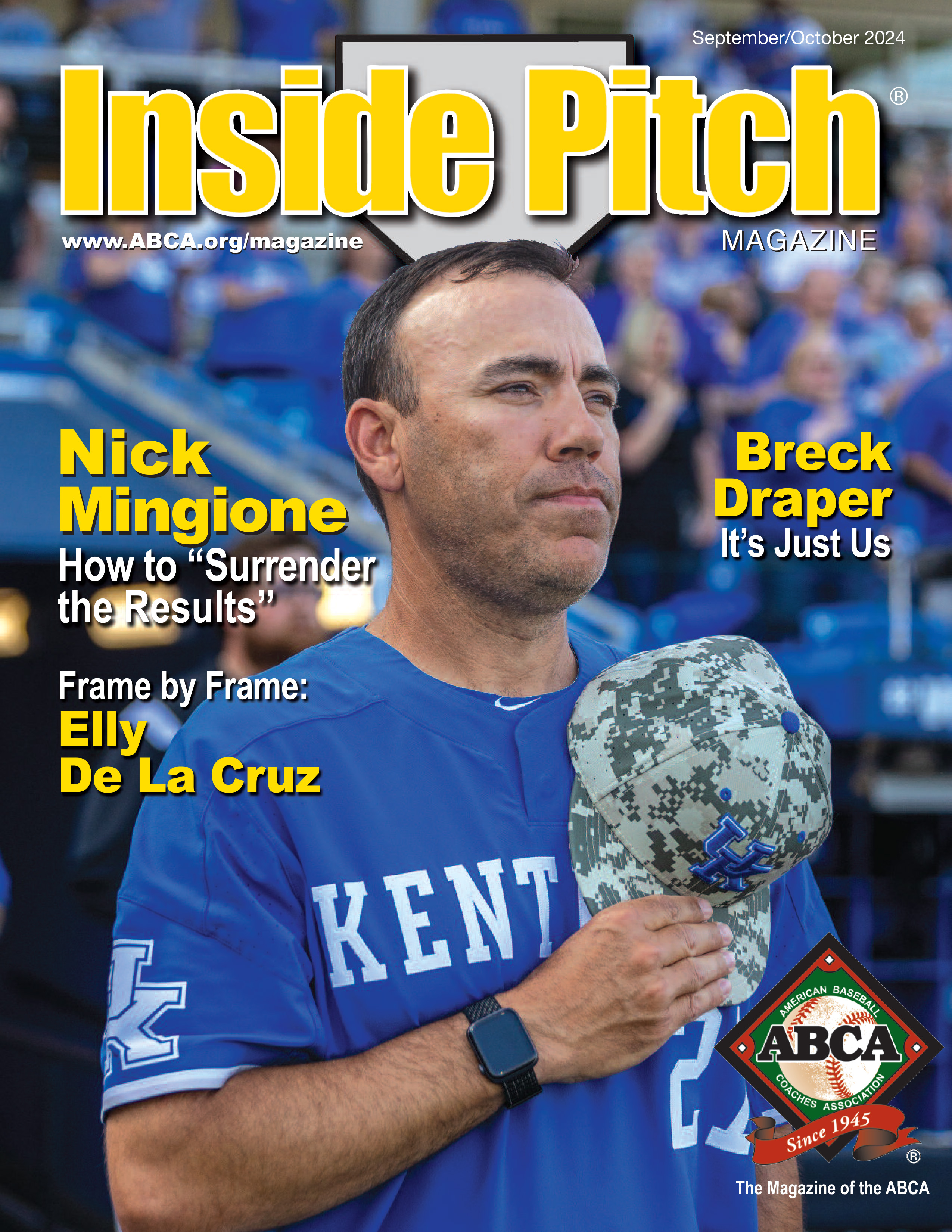
Nick Mingione led the Kentucky Wildcats to their best season in school history in 2024, which included a school-record 46 wins, an SEC regular season title and UK’s first-ever trip to the College World Series. Various outlets named him National Coach of the Year following two (2017 and 2024) of his eight seasons as a head coach, 42 former Wildcats have been drafted under Mingione’s watch, and 26 of his players have reached the big leagues. Before taking the reins at Kentucky in 2016, Mingione spent time as an assistant at Mariner High School and Embry-Riddle University (both his alma maters), Florida Gulf Coast, Western Carolina, UK, and Mississippi State. Mingione and his wife, Christen, have one son, Reeves.
Inside Pitch: How long were you able to enjoy the success from Omaha before you had to head back to the grind?
Nick Mingione: What an incredible journey, filled with incredible people. From the time the guys got on campus in the fall, the returners immediately welcomed in all the first-year guys, and the team just started becoming a team immediately. But in this era of college baseball, we played our last game in Omaha on a Wednesday, flew back to Lexington, and on Thursday we had our team meeting, which was unlike any other— just filled with laughs and tears. Player meetings went into Friday andSaturday and the next thing you knew, here we go—visits on Sunday and Monday and it really has not slowed down. But that’s the way it goes now—it’s an immediate “move on” to the next thing.
IP: Will you attempt to “reverse engineer” last year’s success as it relates to roster management or team building?
NM: We had nine guys sign pro, including our first baseman, second baseman, third baseman, shortstop and all three starting pitchers from our weekend rotation. So this coming year will be a totally different opportunity with a totally different team, and we’ll need to take a totally different approach.
IP: How tempting is it to try some new things, new areas, different strategies with recruiting after the attention your program has following last year’s success?
NM: It’s intriguing, but our identity will remain with recruiting high school prospects and filling in the pieces with the portal. We have figured out an identity here as far as pitching, defense, and offensive styles that we like, and—now that we have that formula—we’re trying to find the right pieces to plug in those gaps so we are able to do what we believe it takes to be successful here at Kentucky.
IP: What have you learned through the process of hiring assistants in terms of creating that culture and helping you build the program?
NM: One of my favorite things about last year was that I had three former players on staff. I never knew how much I would truly enjoy watching them do what they love, and teach me; Trevor Fitts was a starting pitcher from our 2013 national championship series when we were at Mississippi State, Nick Ammirati was the starting catcher on that same team, Logan Salow was an All-American here at UK. Being around them again on an everyday basis was so rewarding. Add that to consistency of Austin Cousino, Dan Roszel and Brock Doud...their knowledge and presence has made all the difference.
IP: How about team building in the era of NIL and the portal? You don’t have much time to establish a culture, do you?
NM: It starts with the players that are already in your program. We don’t have seniority here, and there’s not a pecking order. I think in order to have a championship culture, everybody needs to feel appreciated. Our returning players have done an unbelievable job of welcoming in all the first-year players. The word “family” is thrown around a lot. We’ve had players talk about how they’ve been to three or four schools and “they all say ‘family’, but you can feel it here at Kentucky.”
IP: How do you mean?
NM: I think it starts with the coaches’ wives and kids, who are always around the ballpark. It’s a legitimate family atmosphere here where everyone is hanging out and always around, and it’s a huge part of what we do. You can’t throw around the word “family” unless your families are truly involved, and our families are.
IP: People throw around “championship culture” a lot too; what are some ways you develop yours at Kentucky?
NM: Shawn Umbrell is our director of impact leadership here at UK—he is outstanding. He spent 27 years in the U.S. Army and does a series of sessions where we are meeting with our players, breaking into small groups and just working on our culture, which I think comes down to this:
- What you allow...we allow our players to be themselves
- What you reward...we reward meeting the standard that is set by our league
- What you reinforce...we reinforce being a great teammate
- What you do or do not accept...we accept aggressive mistakes, but we don’t accept whining, complaining or making excuses
The fifth element is the consistency piece; all those things have to happen on a daily basis.
We are constantly working on feeding that message to our guys so we can find out what’s truly important to them. Then as a result, you’re able to build that “championship culture” we’re all chasing, where everybody feels appreciated and there’s a real consistency within the program.
IP: What’s your personal journey been like as a head coach as it relates to your immediate success and then climbing the mountain again this past year?
NM: So I was a first-year head coach at Kentucky and we went into the last weekend of the regular season with a chance to win the SEC, we hosted a regional for the second time ever, which we ended up winning and went to our first-ever super regional. I’d be lying if I told you that I wasn’t like, “man, that was easy!” And boy, as you know, you get humbled quickly in this game. The next year we missed the postseason, in 2019 we finished dead last in the SEC, and then COVID came in 2020.
During that time, I went back and reevaluated every piece of our program: the field, the way we played, our personnel, our evaluation process, even the way we recruited… we looked at all facets of the program during that time. I called some former players and got some good, honest feedback from them about what they experienced, what they had seen, what they thought was missing.
Fast-forward to 2021. We fell just short of the postseason again, and in ’22, I truly believed we had a special roster, a regional/super regional-level team, and we lost our Friday starter and our Saturday starter, boom-boom. I was crushed for those two guys, and for everyone in our program. In the SEC you can have one “flat tire” on the trip; you’re going to fall behind, but eventually you get that spare on and get back in the race. But when you have two flat tires, you’re stuck, and the league is going to pass you by. That’s what it felt like.
IP: And that was when you’ve mentioned taking a different approach…
NM: I finally got to a spot where I just got on my hands and knees and I’m like, “Lord, I’m done trying to do this on my own. I’m done chasing rings and this ‘trophy’ of Omaha, I’m done chasing the postseason. I’m just done.” I surrendered and I just gave him the season. We ended up making some changes that had a profound impact; we put Nick Ammirati back in the dugout, I went back to coach third, we started catching Devin Burkes more. And I made a commitment in ’22 that every morning I would start my day in my Bible, which is the best way for me to truly “surrender the results.”
IP: Is there something you’ve specifically learned from that commitment or just a feeling of surrender?
NM: It’s not what you’re playing for, it’s who you’re playing for. I stopped chasing the trophy and it’s really remarkable—now we have some! SEC regular season, regional champs, super regional champs and the “trophy” of going to Omaha. But to this day, I haven’t carried those things around, hugged them or anything. I’ve touched it and the hardware is awesome for sure, but it’s not what I’m doing this for anymore.
I’ve also learned that God has blessed our staff with legitimate talents, and I’ve had to learn to let go and let the coaches utilize those gifts. Now, if I see that something’s off track, I’ll nudge the boat a different direction, but I just keep that bird’s-eye view of what’s going on so our coaches can do what they love.
I believe that God has also blessed me with the gift of encouragement, so being back in that third base box and getting back into the fight with the players has allowed me to lift them up and let their own lights shine.
IP: Surely you feel like ripping somebody a new one from time to time though, right?
NM: Some of the best advice to follow as a coach is “do not forget what it’s like to be a player.” I try to remind myself of that every day. The amount of pressure and stress and everything else the guys feel here is far greater than I believe that we could ever realize as a coach.
IP: And more than we ever faced as players…
NM: Right! When you think about social media and new draft process and families back home and NIL and the portal and the access and the visibility? Everything is being recorded and it’s archived forever—everything. And of course, I want to lay into a player at times and I get so mad sometimes, but I try my best to show our players the respect they deserve, the respect they have earned.
IP: So what is it that sets you off?
NM: I can handle aggressive mistakes, but when our guys are timid or scared, that is not okay. So there are times where I have to bite my tongue and just hold back, and I don’t always hold it all back! But in this day and age, most players are aware of what the standard is, so when they don’t meet it, they already know.
IP: How do you manage the dugout?
NM: Our players are responsible for two things: how they play and how they help the team outside of how and when they are playing. Say you just struck out and you’re walking back to the dugout. If you have something that can help the next guy, you’re responsible for telling them. If you’re in that dugout and you’re not playing, you are responsible for helping the team. And we have a bunch of 18 to 24-year-olds who are quite creative on how they do that. I don’t care if pitchers who aren’t pitching that day are wearing eye black. This past year’s team coined the phrase “get weird” and a freshman brought a pink hat to the first game and Mason Moore was wearing it—he started dealing right after, so it stayed around.
I just want them to be the best version of themselves and to help the team; so as long as they’re doing that, there really aren’t many things I’ve had to say “no” to because they understand that.
IP: What’s something you never used to do that you always do now? Or vice versa?
NM: Wow...I’ve made a ton of adjustments from when I started coaching, typically as a result of adjustments from years or stretches we haven’t done as well as we would’ve liked. But we do start every practice with a “quote of the day,” which hopefully puts our players in a good space mentally and frames the message they need to hear that day.
Another thing we do is a team challenge, so they know immediately that they’re in “compete mode” the second that warmup is over. It could be a defender catching a popup, getting a bunt down in a certain spot, glove flip on a squeeze play. We’ll use a machine to shoot a ball down to second base, middle infielder has to run, pick it and put a tag down on a stolen base. It could even be back to the field, infield popup, do two pushups and try to find the ball and catch it, anything to challenge them. We haven’t thrown at this point so anything that doesn’t require that element, fire it up.
One thing I don’t do anymore? We don’t talk to the team about winning. Our focus is trying to do what it takes to win and as a result, we believe we’re going to win, which is much more productive than talking about and trying to win.
I’ll meet with the team after every game—which I haven’t always done—and we go over our standards, we put it out there, and I give the players the opportunity to speak. And the meetings are dramatically shorter after a loss. And win or lose, every game has a midnight expiration. You went 4-for-4 with four jacks? Don't be walking in here tomorrow with your chest popped out. O-fer with four punchouts? Don’t come in with your head down. Good or bad, it’s over at midnight, today is a new day, and victory must be earned every day.